
By Joanne Rodgers,
Bruce Peninsula Press
As global attention turned skyward following the high-profile Artemis II launch, closer to home is a local connection to the first Canadian Astronaut Team.
In the 1960’s, Dr. George Harpur, a medical doctor with the Canadian Air Force, was working for the Defence and Civil Institute of Environmental Medicine (DCIEM).

This organization was tasked with “investigating the effects of occupational hazards such as cold, heat, impact, and pressure on pilots and divers. Survival testing of clothing and food was also carried out in an effort to increase safety and assess risks.
The effect of G-forces on pilots was researched in a human centrifuge, while hypobaric and hyperbaric chambers were used to study decompression sickness, aka ‘the bends’, a problem for both divers and astronauts.” (Source: Downsview Park)
At the time, the research around decompression sickness had serious implications for both military operations and future space exploration. Amongst the researchers at the lab, this pioneering research generated a lot of speculation about Canadian participation in space missions. Some of the tests conducted at the lab were far more rigorous than any situation that was expected to be actually encountered by the astronauts in space.
For Dr.. Harpur, the possibility of getting into space arose because of a little known project, the Manned Orbiting Laboratory (MOL), initiated by the United States Air Force during the Cold War as a way to scan Soviet Russia from space. There was an expectation it would include a Canadian participant from among the group working on these issues. But alas, the project was cancelled in 1969, just before Dr.. Harpur left the Downsview research lab to enter practice in Huntsville, Ontario.
Dr.. Harpur noted that life at the lab had its lighter moments. He recalls that his outstanding ears became an issue of contention at one point when he got his head stuck in one of the goldfish bowl space helmets and a debate arose over whether to break the prohibitively expensive helmet or modify his ears in order to get him out. He hastily wriggled free, ears intact.
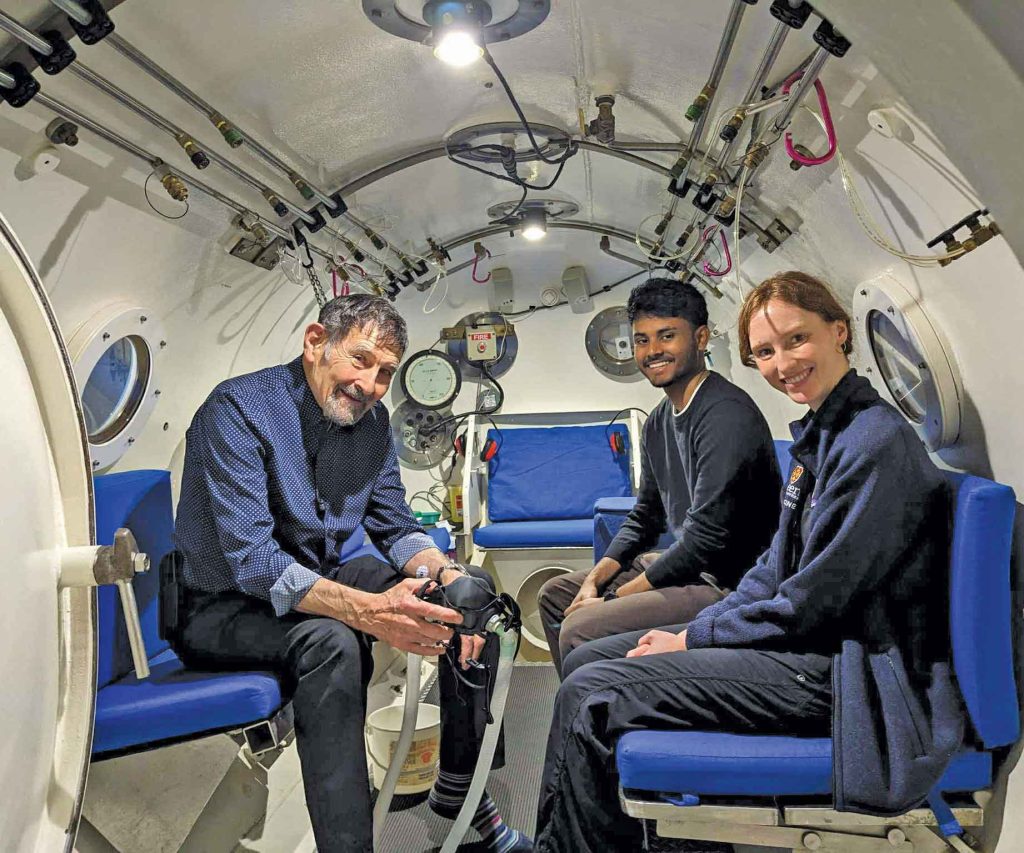
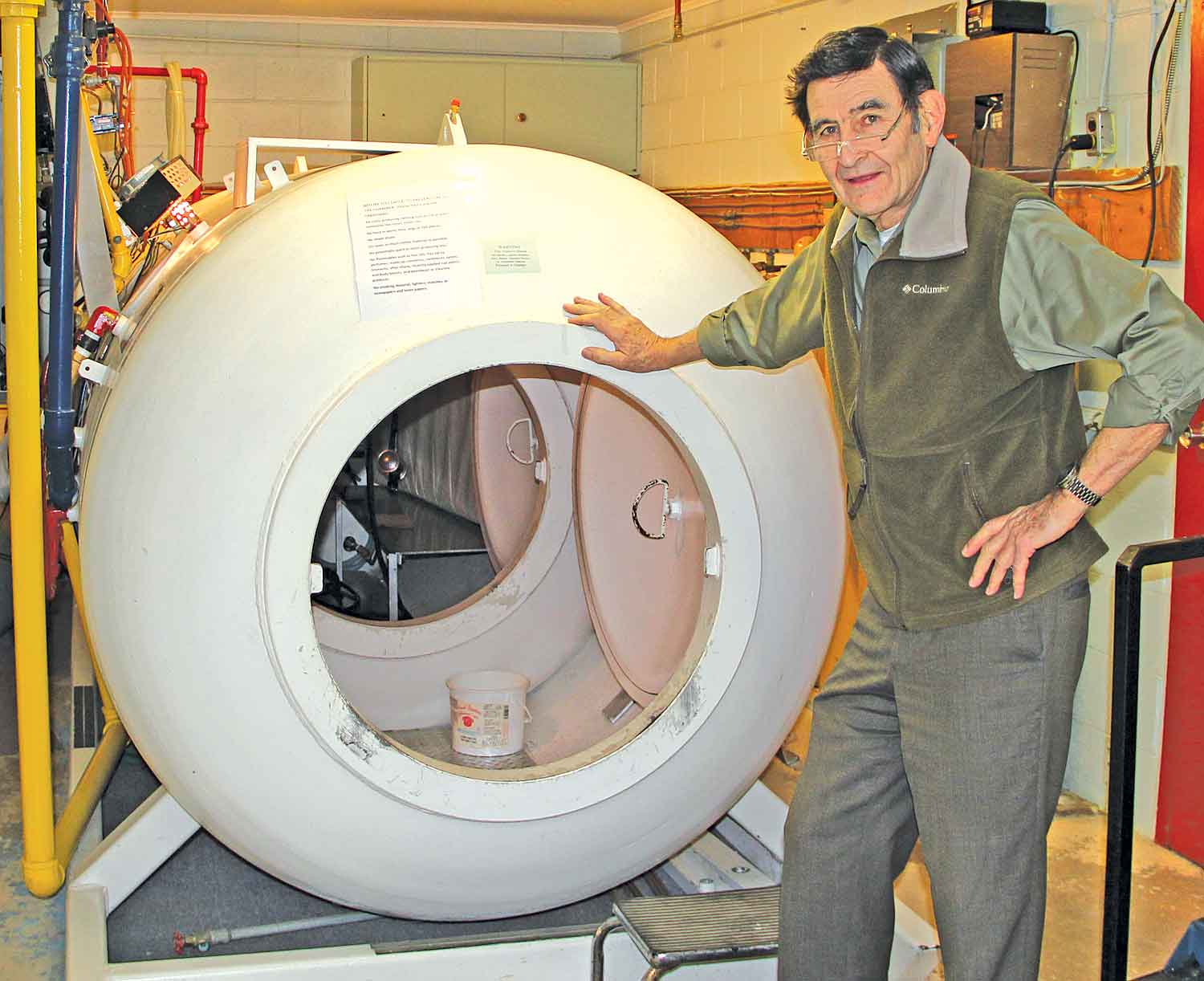
Dr. Harpur moved to Tobermory in 1974, enticed by an agreement with Natural Resources Ontario that would provide the funding for a hyperbaric chamber in Tobermory to support the Fathom Five Marine Park and the opportunity to practice family medicine at the, yet to be built, Tobermory Health Clinic. Over the next ten years, with the hyperbaric chamber and clinic in operation, Dr. Harpur continued to be very active in the hyperbaric and diving medical communities doing general practice, conducting medical application of hyperbaric oxygen therapy, and offering support for diving emergencies in Fathom Five Marine Park along with Dr. Ralph Suke.
Dr. Harpur’s second opportunity to get into space came in 1983. Now in his forties, Dr. Harpur was one of 32 selected from among the approximately 4,000 applicants who responded to the call for applicants for the newly planned Canadian Astronaut Team. He was in illustrious company, being in the same interview session as Dr.. Ken Money (one of Canada’s first six astronauts) and Dr.. Roberta Bondar (the first Canadian woman astronaut). Dr.. Harpur was not selected as one of that group but was asked if he was willing to let his name remain on a secondary reserve list.
While never called up for a space mission, he found the selection process and interviews interesting and the 1983 experience gave rise to some reflections on what he most wanted to do.
At the time, Dr. Harpur and Dr. Suke were awaiting a decision on a research grant for a study examining the effect of hyperbaric oxygen therapy (HBOT) on chronic stable MS. He recognized that he might have to face a choice between space and this important medical study. Dr. Harpur says that he now feels fortunate that the decision was made for him, as the chance to go into space would have been amazing, but with the huge problems we have right here on earth perhaps we would do well to direct more of our resources and energy to less lofty endeavours.
Dr. Harpur is retiring from work in his area of research and practice and with the Hyperbaric Chamber in Tobermory, He maintains his connections to the aerospace industry and still lectures yearly at the School of Operational Medicine (SOM), Canadian Forces Environmental Medicine Establishment, Downsview, ON.