



Submitted by the Bruce Peninsula Biosphere Association
A project put together by the Bruce Peninsula Biosphere Association this summer, managed by Digital Skills Ecosystem Technician Krista Dovaston, a Marine and Freshwater Biology major from the University of Guelph, and assisted by student Kristianna Murray, oversaw the removal of over 1000 square meters of invasive Phragmites from 20 locations around the Peninsula. The project, with the support of the Nature Conservancy of Canada, identified areas of Phragmites growth using the Conservancy’s invasive species database. It focused on patches on Stokes Bay, Gauley Bay, Little Red Bay, Oliphant, and Bradley Harbour, among others.
Phragmites is a non-native reed that originated in Eurasia. It’s an aggressive spreader that wreaks havoc in wetlands and beach areas by crowding out native plants and animals (even poisoning them via a toxin in its root system), lowering water levels, and impacting recreational activities like boating and swimming.

The plant can grow in thick clusters with as many as 200 plants in a square meter, with stalks growing up to five meters in height – its native counterpart is smaller and grows less densely, allowing other species to flourish.
Alarmingly, the invasive plants can still commonly be found in garden centres, despite their notoriety as a threat to Ontario’s water systems and their peripheries.
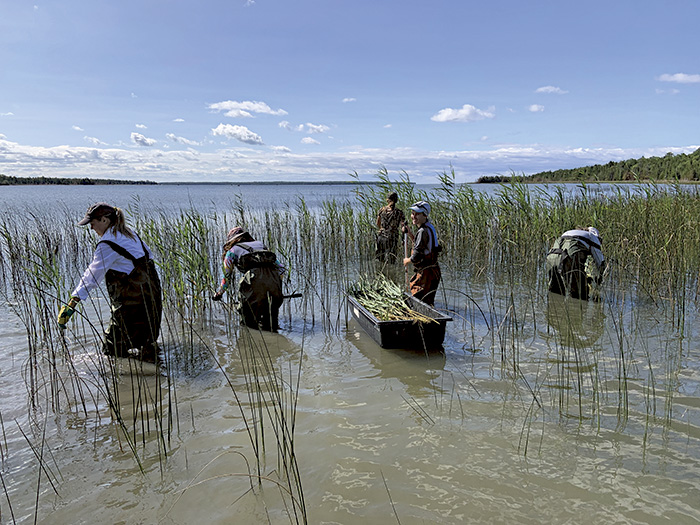
Wearing waders, long sleeves, and gloves for protection, the Biosphere team used the “cut to drown” method, which severs the plant as close to the root as possible, removing its access to oxygen and light so it is unable to photosynthesize. The seed heads are then removed from the cut stalk and bagged up separately before being disposed of.
Dovaston and Murray went out a total of 17 times starting August 6th, for up to six hours each day. They were accompanied by members of the Nature Conservancy for roughly eight of the cuts, and by up to ten volunteers on two separate “community cuts” that invited the involvement of locals. They commonly came across the very wildlife they were looking to protect by removing the invasive plants, including fish, frogs and tadpoles, egrets, and other waterfowl.
Phragmites spreads through the disturbance of wetlands due to shoreline development and the operation of watercraft. These activities kill off more sensitive plants and allow invasive Phragmites to thrive in their absence, invulnerable as they are to poor nutrient levels and the presence of heavy metals in their environment. The best way to reduce their spread and encourage the return of native species is to avoid these disturbances in the first place. In cases where Phragmites have already taken hold, they must be disposed of carefully and properly.