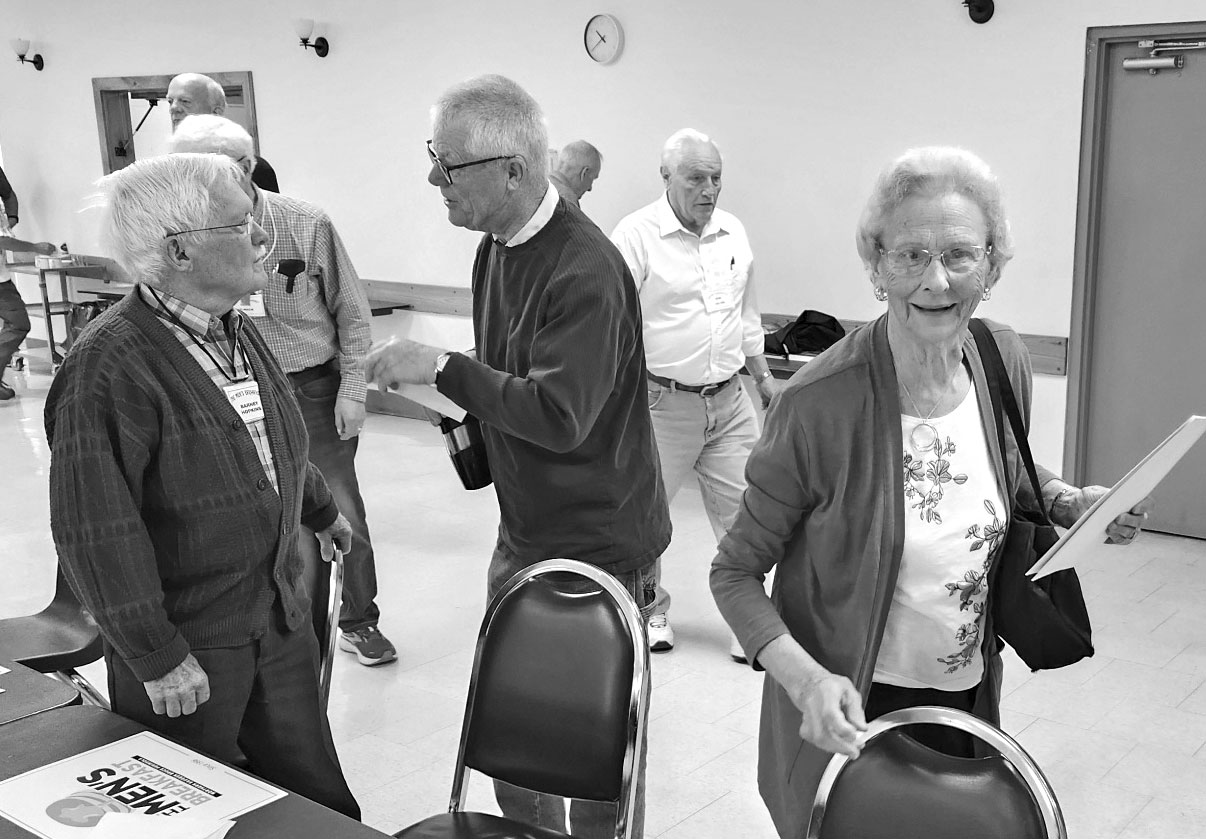
Submitted by the Men’s Breakfast
The last Men’s Breakfast (June 8) fell near the 80th anniversary of D-Day. We honoured the occasion with a remembrance of many of the women and men from Tobermory and vicinity who served during the 2 World Wars, Korea and in Afghanistan.
Rob Davis, with support from Shirley Johnstone and Barney Hopkins, provided an excellent history covering the former wireless station at North Point, our local Legion and many veterans. All three are local residents and long-standing members of Branch 290. Rob was born and raised in Tobermory and has lived here full time for the past 14 years following retirement. Shirley moved to Hidden Valley and what became known as the Johnstone Farm in 1952 with her husband (“J.P.”) and a one-week-old baby girl. Barney is an air force veteran who has lived here all his life with the exception of his service time.

Built in 1912 at North Point, the wireless station was one of eight Canadian wireless operations on the Canadian side of the Great Lakes. With two large buildings and two high (185ft) radio masts, it played a critical role in communications with and between ships. With the beginning of WWI, there was concern that it could become a German target. The Army and the government sent an Expeditionary Force of 15 soldiers to hold and protect it.
World War I found Tobermory with a population of around 400 involved with fishing, farming and lumbering. In 1915 a meeting was held resulting in the formation of the 160th Bruce Battalion including 29 men from Tobermory (St. Edmunds Township). A total of 44 men from Tobermory served in this war. Many returning soldiers had been impacted by poison gas, hearing loss, PTSD and wounding. Wounded soldiers included Witt Hopkins (amputated hand) and Earl McFarlane (amputated leg), while 6 lost their lives: Norman Finley Campbell (30yrs); Stuart Campbell (23); John Earl McLeod (23); Frederick Millward (37); Angus Smith (27); and Harry Willaughan (38). Daniel Adams and Arthur Martin both received the Military Metal for bravery and Arthur was also awarded the British War Metal the Victory Medal and the 1914-1918 Star. Norman Finley Campbell (30) was awarded the Purple Heart (U.S.) as his Regiment was serving along with the American Army at the at the time of his death.
Tobermory’s men and women again stepped up with the onset of World War II with 57 men and 5 women enlisting, 28 of whom served overseas. Tobermory’s families made significant sacrifices in terms of sibling involvement: Adams family (5 sons); the Belrose family (3 sons, one killed); the Davis’ (3 sons and 2 daughters); the Hopkins’ (2 sons in the war and 1 – Barney Jr – with NATO post-war); Simpsons’ (3 sons); and the Wyonchs’ (1 son and 2 daughters). Sergeant William Thomas Clifford Woods was presented with the order of the British Empire (M.B.E.) by King George VI and Sergeant Thomas Alexander Edward Hopkins was awarded the Military Metal for Bravery serving with the second wave of those who landed at Juno Beach and went on to help liberate Holland. Sergeant Albert (“Bert”) Hopkins was awarded the U.S. Bronze Star Medal, the 1939 – 1945 Star, Italy Star, France and Germany Star, the Defense Medal with Clasp, the Volunteer Service Medal and the 1939-1945 War Medal.
Bert was a member of the 1st Canadian Special Service Battalion – known as part of the “Devil’s Brigade Company”. Coined by German forces and also referred to as the “Black Devils” because they mostly operated at night and behind enemy lines, this brigade was formed by the combination of the Canadian Battalion and U.S. Army volunteers who underwent special training. They were trained in guerrilla tactics, mountain climbing and fighting, winter combat, hand-to-hand combat and the use of Allied and German weapons. In a sense this unit was a forerunner of the U.S. Green Berets.
The Tobermory Legion was first organized in 1919 by returning WWI veterans. One of the first acts was to erect a Cenotaph at the current location. The Cenotaph was expanded to include local veterans of WWII and the Korean War. The Legion received its Official Charter in 1938 with A.S. (Art) Martin serving as its first president with T.A. Golden and Martin Hopkins serving as vice presidents. The first building was constructed in 1946 with the support of a collected fund of $230 on property donated by the president. A hunting clubhouse on Cove Island was dismantled and brought to Tobermory to begin construction which was completed in 1948 with the aid of support money from the Township ($1,000) and County ($500). The hall was expanded in 1991-92 with remodeling of the kitchen area, relocation of the staircase and a new roof (which we just replaced this month).
Our next Men’s Breakfast is on July 13th, at the Tobermory Community Centre. Our guest speaker will be Elizabeth Thorn, Chair of the Bruce Peninsula Biosphere Association, who will speak about their latest projects. Please consider joining us.