Media Release
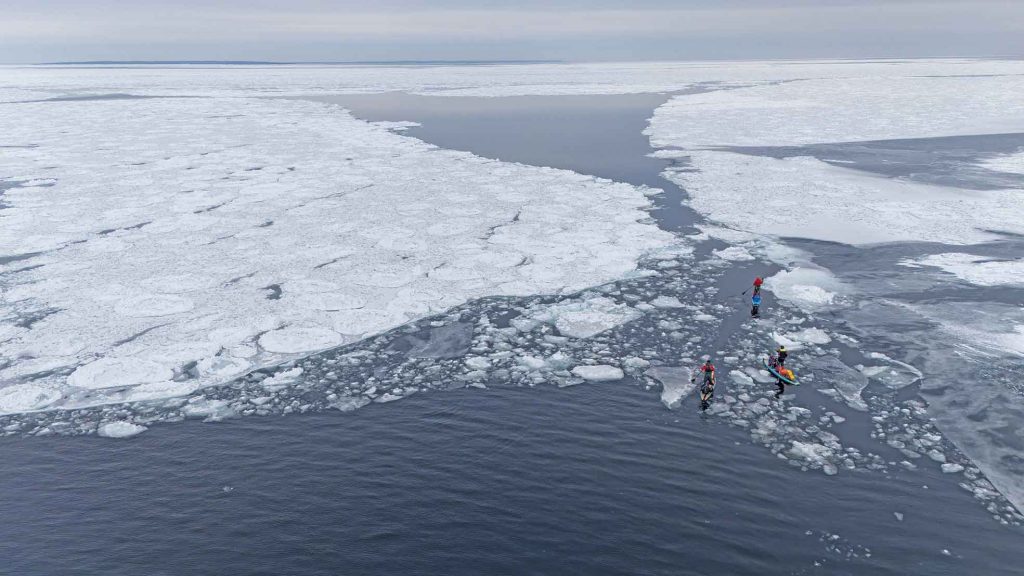
March 2026 TOBERMORY, ON – Three local adventurers from the Saugeen (Bruce) Peninsula have successfully completed a historic winter crossing of the Fathom Strait, trekking and paddling 56 kilometres over a 5 day expedition from Tobermory to Manitoulin Island. Scott Parent, Andrew Ryzebol and Billy Shearer began the expedition on March 2. Four of the next five days were spent navigating a constantly shifting arena across drifting ice floes, pressure ridges, and open water, arriving March 6 in South Baymouth. This marks the first human-powered winter traverse of the route in the modern era.
Along the journey, the team dedicated an entire day to freediving the historic City of Cleveland shipwreck near Perseverance Island. Located 30 km offshore from Tobermory, the wreck is difficult to access even in summer, making an ice dive particularly remarkable. The steamship sank in 1901 during a September storm, highlighting the region’s harsh conditions.


Hauling two hundred pounds each, including winter camping supplies, freediving gear, and safety equipment, the trio relied on a hybrid travel system combining modified stand-up paddleboards (SUPs) mounted on ski-sleds combined with mountaineering techniques to traverse mixed ice conditions and open water. The successful crossing was the result of more than a decade of preparation, systems refinement, and daily monitoring of ice and weather conditions.
The expedition expanded on amphibious hard-water travel systems developed by Scott Parent and Zane Davies to complete a winter crossing of Georgian Bay in 2015 from Cape Croker to Twelve Mile Bay. That journey pioneered using modified SUPs as multi-purpose winter expedition craft, serving as hauling sleds on ice and paddle craft on open water.

Two previous attempts to cross the Strait in winter were abandoned due to deteriorating ice conditions and strained gear, including one in 2019 by Parent and Davies, and another in February 2026 by Parent, Ryzebol and Shearer. Ice conditions across the strait can be highly destructive due to currents that keep it in constant motion. Roughly 30 km of the crossing were navigated by trek and 26 km by paddling open water, while navigating through the ice-floes. Sections too thin to walk yet too thick to paddle were overcome using ice-breaking strategies.
Safety message
Offshore Great Lakes ice is inherently dangerous and demands vigorous training and preparations. These lakes behave more like oceans than smaller lakes that many Canadians are accustomed to, with ice moving and open water appearing rapidly. Ice thickness alone is insufficient for decision making; concentration, wind, currents, temperature fluctuations, and ice structure all matter. Proper knowledge, planning, training, preparedness and self-rescue capability are essential to allow safe passage without emergency intervention. Explorers must respect the ice and have the discipline to adapt as conditions change.