



By Tessa Swanton (Townson),
Bruce Peninsula Press
A Virtual Open House on April 9th hosted by the Municipality of Northern Bruce Peninsula (MNBP), presented by Chief Administrative Officer (CAO) Peggy Van Mierlo-West, and facilitated by Michelle Casavecchia-Somers and Michelle Smibert from Clerks on Call, leveraged over 200 registrations for the online event and almost 1,000 public surveys completed regarding the future of the Cabot Head Road (CHR) in Dyers Bay.
Casavecchia-Somers and Smibert, experienced CAOs and Clerks, said, “Public involvement for this project has truly been amazing.” The extensive public interest in the future of CHR speaks to the project’s connection to the community from an emotional, cultural, and historical standpoint.

Proposed Operational Model: Controlled Vehicles and Public Multi-Use Trail
Council agreed on a proposed operational model for CBH consisting of two access systems: controlled authorized vehicle access and public multi-use trail. Vehicle access would be restricted by a gated system allowing only contractors, staff, emergency services, Friends of the Cabot Head Lighthouse and Bruce Peninsula Bird Observatory. Permits and agreements would be mandatory for vehicles allowed entry including logs, signage and optional surveillance. The public multi-use trail would allow walking, hiking, and cycling and feature a trailhead kiosk with maps and safety information, wayfinding signage, and rest areas. MNBP would be responsible for maintaining the trail, gate system, monitoring access logs, conducting inspections, trail grading, trimming, drainage, erosion tracking, and enforcement.
Full comments from provincial and federal agencies and First Nations will not be made until a decision is reached by Council on how to proceed with the road.
Survey Data Results Show Support for the Proposal with Some Concerns
The current proposal of authorized vehicle access and public multi-use trail received 76% support from survey respondents, 50% of which were strongly in favour along with 8% neutral, 6% somewhat opposed, and 7% strongly opposed.
Most respondents supported the installation of a gate but want to ensure it works properly to restrict trespassers. To manage the site, providing trespass fines and ticketing, increased by-law enforcement, and camera monitoring and warning signs, were all popular methods. Data revealed that 79% of respondents support public access to CHR through a trail. “They want to see nothing overbuilt, just enough to make it safe and useable,” said the CAO.
Environmental concerns were prominent in the survey results with 85% stating that protection of the environment was extremely or very important to them. Wetland and sensitive habitat and waste management were the most important environmental priorities. “Respondents want to ensure that the area does not become overcrowded by overtourism,” noted Van Mierlo-West.
Recorded data suggests that of the 946 survey respondents ranging from age 45-79, 39% are year-round residents, 37% are seasonal residents, 72% are from MNBP, and 94% have visited Cabot Head. Respondents ranked public access and environmental protection as the most important priorities overall.
In summary, the CAO emphasized that “the key message is that conservation must take precedence.” Further she said, “Concerns were brought forward regarding the potential of overtourism without appropriate management…In return the potential for serious environmental damage could occur.”
Regarding parking concerns, “Currently there are no plans for any large parking areas or new development of parking areas. We want to avoid traffic problems, keep the community safe, and prevent illegal parking,” she confirmed.
Comments During Open House Mostly Reveals Parking Concerns and Trail Support Subject to Conditions
A Cabot Head property owner stated, “The trail doesn’t actually start at Cabot Head, it starts at the beginning of Dyers Bay because there’s no parking in Dyers Bay available for those going to use the trail…Currently we have individuals that park on private landowners’ property at their own free will…It hasn’t been addressed in the past and I imagine it’s only going to get worse moving forward.”
One commenter was concerned with the lack of attention to accessibility. “We want to make an appeal that the needs of the disabled are not just casual for when it suits us…It’s a judge, I would say, of who we are as people by how we care for those that are most vulnerable…And that’s what’s disappointing of how little indication that that would be taken seriously.”
Another commenter with extensive experience advocating for the reopening of CHR as a trail commended Council on this initiative. “I think it’s one of the most spectacular bike routes potentially in Ontario. The lighthouse has a symbiotic relationship to the road, without a road or trail being improved the lighthouse is doomed…The lighthouse has been broken into five times in the last three years and significant damage has happened…There’s no way to save the lighthouse and access to Wingfield Basin unless we have a trail…There should be no parking in Dyers Bay.” They continued, “Maintenance of the trail would be municipal…Consider the maintenance of the lighthouse as part of that package, the two are interlocked – we need to think about both of them at the same time, one can’t really exist without the other…If the trail doesn’t have a destination there’s no point in a trail and if there’s no way to get to the lighthouse, there’s no point in maintaining the lighthouse.”
One speaker encouraged the Municipality to start using a Visitor Use Management Framework to “help navigate the situation.” “There’s a lot at stake here, Cabot Head, Wingfield Basin, and the lighthouse itself have so much cultural and natural heritage features that I would be broken hearted to see cut off from the community and public at large,” they voiced.
Another speaker suggested making the trail accessible for mobility devices, paving the trail with a bike/pedestrian lane if shared with vehicles, and restricting vehicles to certain times.
Several comments were made regarding the importance of directing parking away from the Dyers Bay community and private property, employing adequate by-law enforcement to keep people from participating in illegal activities like hauling away rocks, camping, setting campfires, littering, and blocking parking.
A few participants expressed disagreement with the proposal.
CAO Van Mierlo-West concluded the open house by affirming, “Thank you for the input that’s been provided today, it’s been really great to hear everybody’s comments and thoughts regarding the project itself…I’m very grateful, it’s been a wonderful experience and one of the highlights of our public engagement projects that we’ve worked on.”
Brief History of Cabot Head Road
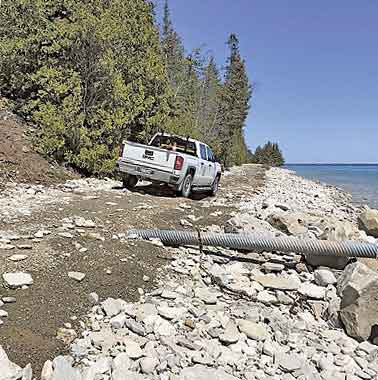
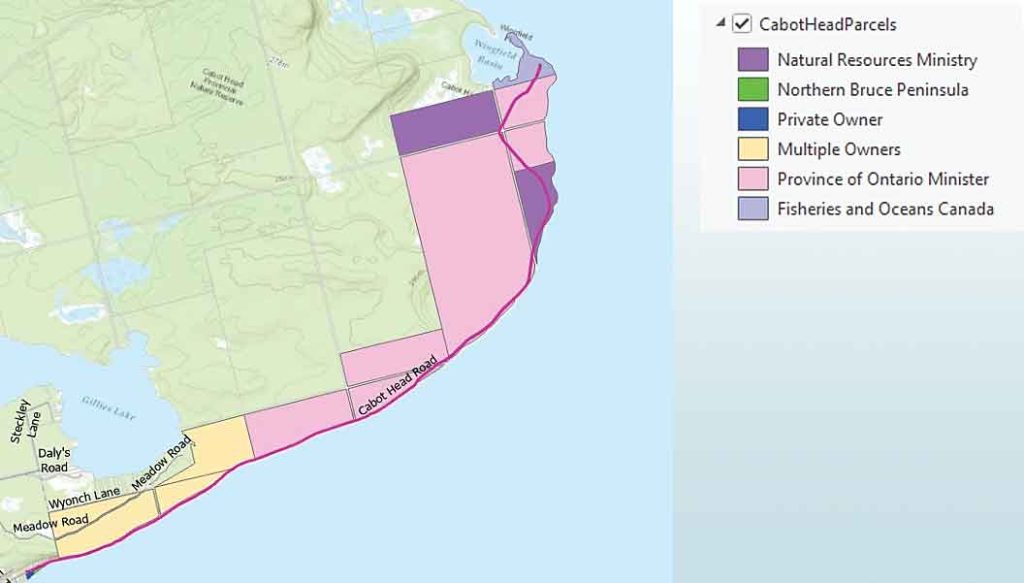
The Cabot Head road was constructed in 1962 to provide easier access to Wingfield Basin, a protected natural harbour, under an agreement between the former Township of Lindsay and Department of Transport. According to the CAO, the road was never legally transferred and MNBP has wheel track rights only, no legal ownership. The road became severely damaged following a 2019 storm prompting its closure to the public. The road remains closed today. A request from Council in 2025 initiated review of the road and the possibility of reopening to the public. The road leads to the historic Cabot Head Lighthouse, constructed in 1895, which is currently also closed.
For more information on this project, visit https://letstalknbp.ca/cabot-head-road