



Submitted by Elizabeth Thorn
Fertilizer is important on fields but excess phosphorus in streams leads to algal blooms and impairs aquatic habitat, so in 2016 the Biosphere Association applied for a three-year Trillium grant to introduce best practices to reduce “nutrient loading” (phosphorus, nitrates) from soil erosion into local streams. Working with Professor Bulent Mutus of the University of Windsor and his graduate student David Ure, the Biosphere Association arranged field testing of a bioremediation filter they had developed. Over 70% of phosphorus was removed at the test site and full results were published in the Journal of Environmental Management. The biochemistry academics continued to work and developed an even more effective filter that reduced phosphorus loading by 90%!
This collaboration led Professor Mutus, Elizabeth Thorn (Chair of BPBA) and John Rodgers (Vice-Chair of BPBA) to meet weekly since January. They researched possible markets for phosphorus biofiltration products, organized an Advisory Committee and explored how phosphorus remediation products could be manufactured on and sold from the Northern Bruce.

Biosphere Environmental, the Biosphere Association’s second social enterprise was born, meeting the twin Biosphere Association goals of sustainable economic development and conservation. The mission of Biosphere Environmental is to reduce agriculturally-based nutrient loading in watercourses by creating remediation technologies that apply leading edge research that is grounded with practical on-the-ground experience.
A three-year Memorandum of Understanding (MOU) was signed with the University of Windsor to develop and market bioremediation products. Work continues toward the vision of creating a “Research-Based Agricultural Manufacturing Industry Cluster”.
Three important milestones were reached this past summer and fall.
1. 500 kg of Filtration Material
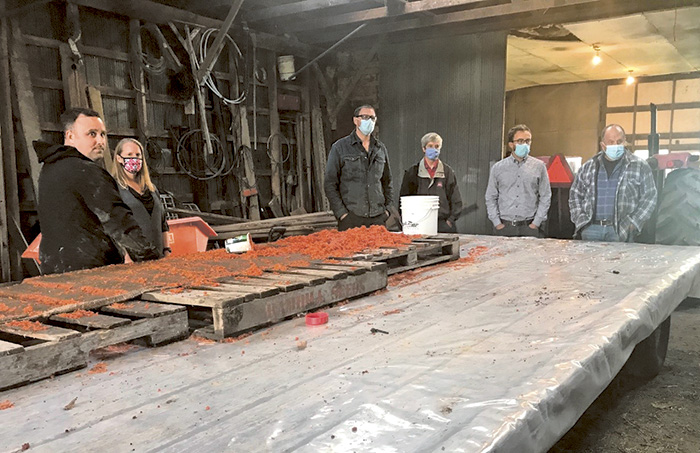
With the assistance of HRSDC funded students Zach Rodgers and Paul Flannigan working under the direction of John Rodgers, preparations were begun. Finally, after a critical element was received, in early October 500 kg of bioremediation filtration material was produced here on the Northern Bruce! Working in collaboration with the Lower Thames Conservation Authority, 400 kg has been installed at a tile drainage test site on the Lower Thames. The field tests will continue until April/May 2021.
Here on the Bruce, Friends of the Greenbelt funding has been secured for the materials needed for Volunteer John Rodgers to create a “casing” to house the filtration material in a tile drain. We are finalizing locations for an additional 3 or 4 field sites to continue our studies and yield a “Proof of Concept”.
2. Manufacturing on the Bruce
Tyler Hayes of EPH TOOLS and Machining is excited about the prospect of producing the bio-filtration material needed for the test sites at his manufacturing facility here on the Northern Bruce. Production is expected to begin in early January.
3. Field Course on the Bruce
Under the MOU, the Biosphere Association organized a meeting with University of Windsor’s Dean of Science, Chris Houser, National Parks Superintendent John Haselmayer, the Municipality’s Chief Administrative Officer Peggy Van Mierlo-West, Community Services Manager Ryan Deska, Professor Mutus and Biosphere Board members. The group toured the Park’s facilities and explored the steps necessary to create a field course here next summer.
The long-term vision is to set up a satellite campus that would be affiliated with Biosphere Environmental’s Research Centre.