



By Tessa Swanton (Townson),
Bruce Peninsula Press
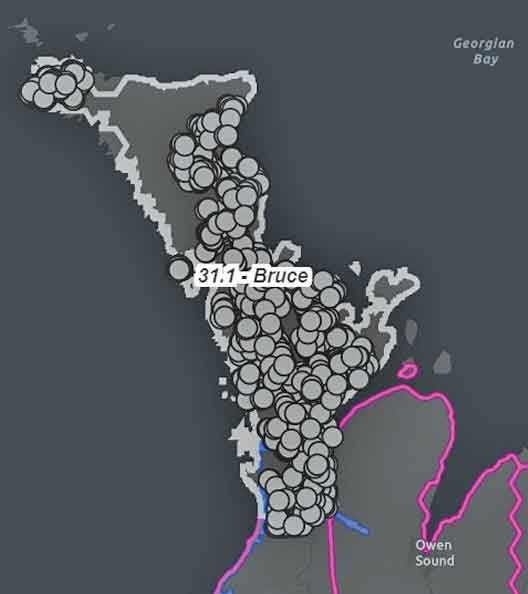
Eastlink Sales and Marketing Manager, Amanda Zurkowski, and Field Technician, Joe Bechard, presented a delegation to the Municipality of Northern Bruce Peninsula (MNBP) Council on July 28. The pair provided an overview of the Infrastructure Ontario Accelerated High Speed Internet Project where Eastlink was awarded builds in Sudbury, Bruce Peninsula, Huron and Lambton Shores. Although the exact number of properties in the Bruce Peninsula (BP) that will be offered connection to the fibre network through Eastlink is unknown, Zurkowski estimates the BP is likely to have most connections of the 7,800 total residences within the project.
Bechard confirmed that door knocking to obtain homeowner consent will commence late summer/early fall. Zurkowski said, “That initial knock we do at the door is to obtain consent from the homeowners to be able to access their property. Even if they don’t necessarily feel they need access to high-speed internet at their home, what we’re recommending is that they get the drops done and completed to their home. That does not mean that they need to sign up for services, it just means that their home is now fibre ready, so in the event that at some point that they do wish to have service, the service is already at that home.”

The build consists of the construction company, Ledcor, installing the main fibre conduits along roadways. Eastlink confirmed that the fibre cable is primarily buried underground, which is favoured over attaching to existing utility poles due to potential issues obtaining Hydro One permits. Next, fibre cables are installed into the conduit and connected to Eastlink’s network and fibre connections are joined using specialized equipment to ensure a reliable connection. The final task requires work on the homeowner’s property with consent. Staff will contact homeowners notifying them of available services. Once a date and time is established, then customers are connected to Eastlink’s fibre network.
The project timeline has started this summer with fibre construction continuing through the fall. Eastlink plans to host community events to correspond with homeowners, answer questions, and sign consent forms. Services will begin to come online in the spring of 2026.
Bechard noted that other small high-speed internet project builds are being installed by GBTEL and Xplore in the region, however Eastlink’s project covers the largest area.
Zurkowski advised if homeowners decide to connect to high-speed internet once the project is deemed complete, then it may cost money. She said, “So there is a world that exists that they may have to pay for this drop beyond this project.” She encouraged everyone who is offered the high-speed internet installation to agree to the free work, as current or future homeowners may be interested in connecting today or in the future.
Council Defers Decision to Opt-Out of Enforcing the Line Fences Act in MNBP
Report No. 25-20 from the Municipal Clerk, Alexandra Croce, was presented to Council at their July 28 Meeting recommending that MNBP opt-out of enforcing the Line Fences Act.
The Line Fences Act is provincial legislation that can be traced back to 1834 and outlines procedure for addressing disputes between adjoining property owners regarding boundary fences. The Act does not cover arguments about fences that are wholly on one owner’s property or property line locations. The Act is applied when no fence exists between two properties and one owner requests a new fence be constructed to mark the boundary, or when an existing fence requires repair or reconstruction. Fence-viewers are municipally appointed professionals who visit the site and make a formal decision on who is responsible for the fence work, what materials should be used, and who bears the costs. Historically, MNBP fence-viewers award a 50/50 cost split for boundary fence disputes.
Croce’s report states that “The Line Fences Act is not the most efficient mechanism for dealing with boundary fence disputes. The Act is quite complex, as demonstrated by a 65-page guide developed and maintained by the provincial government. Miscommunication and confusion at various stages of the process can heighten frustration among parties who are already in conflict.” She noted that dealing with line fence matters places an extensive burden on municipal staff and should be resolved civilly between the landowners.
The Municipal Act allows municipalities to formally opt-out of the Line Fences Act via “Non-Application By-law” and disagreements would be handled by the courts. Currently, MNBP does not have any by-laws regulating fences. Fence-viewing requests are infrequent with only one case being documented in the past several years.
Councillor Laurie (Smokey) Golden stated, “Anything where the Municipality ends up being the decision maker…it puts a lot of strain and stress on whoever is in charge of that and in this day and age maybe it is better to leave it up to the courts.”
Councillor Todd Dowd said, “I think as long as we have farmers and line fences then we need to stick to the Line Fences Act…to rely on the courts is not representing our farmers…some of these line fences we’re talking about a lot of money, if you have 100 metres of line fence that your neighbour is supposed to replace it could be over $10,000 to replace…when a line fence needs to be replaced it needs replaced, you can’t rely on it going to the courts and how long that would take to settle it, and the farmer having no idea whether or not they’re getting any money…until we have something viable to replace [The Act] we need to keep it.”
Mayor McIver acknowledged, “I just want to make sure that our farmers are aware of this and what the implications are.” Council deferred the report and asked Croce to return with additional information regarding “how the court system works.”