



Men’s Breakfast Hears About Groundwater Susceptibility
Submitted by the Men’s Breakfast
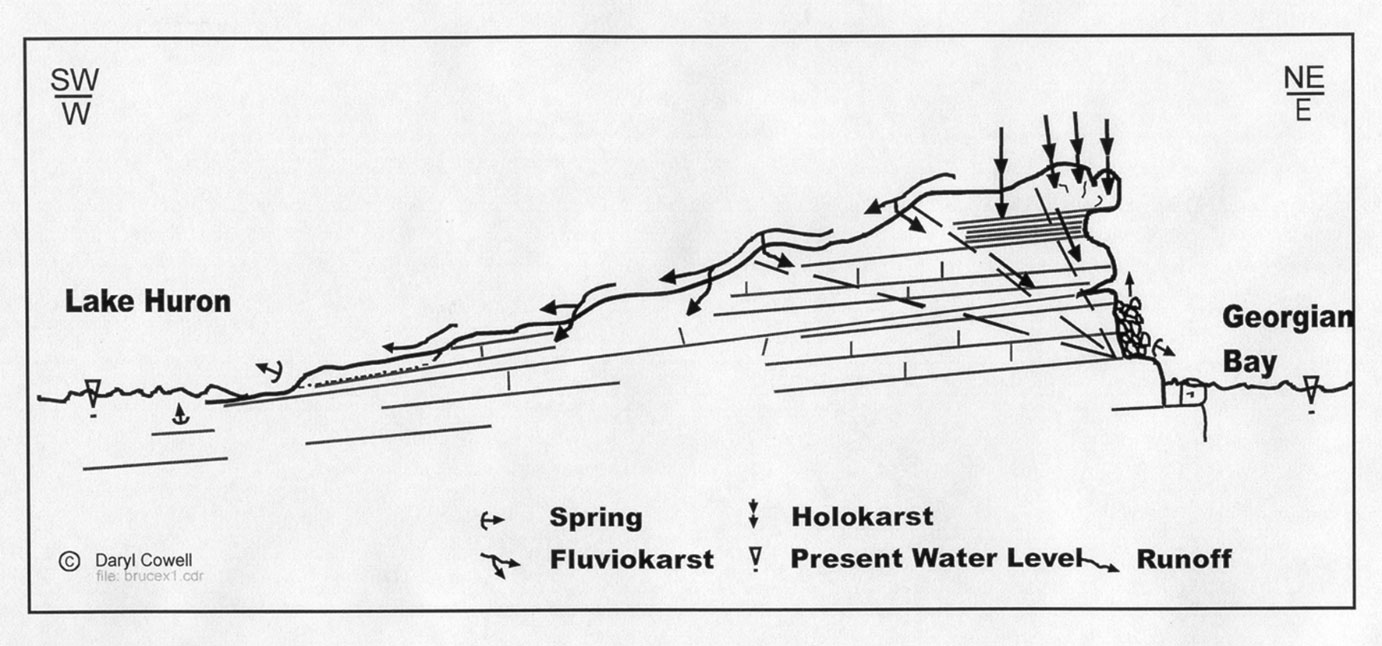
Daryl Cowell, a somewhat well-known local geologist, outlined how our native rocks enhance the susceptibility of our groundwater to contamination from a variety of sources. He described how the highly fractured nature of the local dolomite bedrock results in rapid infiltration of surface water including rainfall, snowfall, streams and lakes. Where bedrock appears at the surface, it is crisscrossed by open fractures formed by internal bedrock jointing. Surface water easily drains into the deeper rock via these openings with no opportunity for filtering by sediments. Where the bedrock is covered by thicker sediments, some filtering can occur, however water tends to accumulate as streams, lakes and wetlands which eventually find an entrance point and drain into the rock mass via sinkholes.

This process is called ‘karst’ which is a term taken from a region in Slovenia (“Kar(r)a”) where there is absolutely no surface water and every rain drop immediately passes downward into the limestone bedrock. Once inside the rock, water drains downward toward a ‘base level’ such as a river, lake or the ocean. On the Bruce Peninsula the lowest base level is Georgian Bay and Lake Huron. At some point in this journey groundwater reappears as springs.
There is a common misbelief that springs and deep groundwater (collected in wells) are natural and clean. Daryl recounted seeing people filling containers with spring water at a spring near Inglis Falls. Above this spring was a large field populated by cattle. You know what cattle do. The Walkerton e-coli contamination several years ago was due to contamination of a very deep engineered well by water running off an adjacent field fertilized with cow manure.
Groundwater can be contaminated by a variety of sources: Underground storage tanks, Individual septic systems (especially if not maintained or poorly constructed), Sewage lagoons, Manure storage, Animal pasture, Landfills, Road salt, Fertilizers, Pesticides, and Gas stations.
Every community has most of these sources but due to our karst bedrock, we need to be particularly cautious. Sewage disposal, for example, occurs as individual septic systems and as collection and transport to a sewage treatment facility. These can be a simple “Primary” system which simply collects and settles the lumps and bumps (like your septic tank). Secondary systems also separate out the solids but aerates the residual liquids using aerobic (oxygen-loving) bacteria to help decomposition. The highest level of treatment – Tertiary – further involves the movement of wastewater through a series of filtering lagoons to allow greater settling and the removal of nutrients (particularly phosphorous) by, for example, wetland plants.
The Tobermory (“St. Edmunds”) Sewage Lagoon is a tertiary system which is regularly monitored. However, when we have the discussion of requiring more infrastructure to meet increasing housing and tourism demands, we must also have a discussion regarding sustainable water supply and wastewater disposal. Distributed individual septic systems already dominate waste disposal methods on the Peninsula; what is our carrying capacity?
Our annual Ladies Breakfast will be held at our next breakfast on October 19th. By popular demand, Ethan Meleg will be returning to present a selection of his amazing wildlife and landscape photographs and tell of his personal adventures in nature photography. All ladies, men, couples and singles are welcome. Please contact Steve, at mensbreakfastnsbp@gmail.com , by October 12th, if you are planning to attend.