





Submitted by the Bruce Peninsula Biosphere Association
In 2020, Canada saw over 200,000 electric vehicles (EVs) added to the roads, with 95% of them in Ontario, Quebec, and British Columbia. With an electricity grid overwhelmingly comprised of zero-carbon emission sources like hydro, nuclear, wind, and solar, Ontario is a great place to drive a vehicle that relies on electricity rather than gasoline.
So, who is making the change to electric, and what is driving the choice to do so?

John and Jane Greenhouse of Tobermory are local EV owners. They made the switch to an EV a couple of years ago when their old vehicle was becoming unreliable. They needed a new car, and they opted for a 2019 Tesla Model 3. The choice of an EV was, in John’s words, “Part economics, part altruism, and part the thrill of something new and different.”
Electric vehicles may cost consumers more up front, but not only are they cheaper to fuel (by about 70%), they lack a transmission, timing belt, fuel injector, muffler, and other parts, and have no oil running through the engine, so they are much more economical to maintain. A 2020 Consumer Reports study estimates that lifetime maintenance costs of EVs are about 50% of gas vehicles. The report also adds that EVs are expected to have longer lifespans overall.
John estimates they spent about $450 in maintenance over their first 50,000 kilometers. “These cars are beautiful to drive,” he says. “Quiet, quick, simple, and economical.”
EVs can be charged at home or on the road at Level 1, 2 or 3 chargers. A Level 1 charger takes at least twelve hours to charge to full; a Level 2 takes six; a Level 3 takes one.
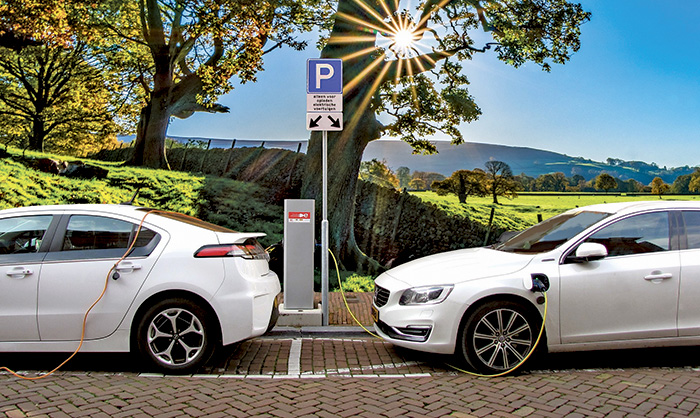
When it comes to longer trips, EV drivers do have to think ahead, but the gaps between charging stations are becoming smaller all the time. By spring 2021, Canada had increased the number of EV charging stations by 15% from the year before, to over 13,000. On the Peninsula alone, the Biosphere Association oversaw the addition of 50 Level 2 chargers between Wiarton and Tobermory.
“No question one needs to think ahead a bit more with [an EV],” says John. “On a trip to California in 2019 we had no issues with our standard range (350km) Tesla as long as we stuck to major highways and cities. The Tesla charging infrastructure is good and getting better, and the car does much of the planning for you. But on minor roads and in small towns you need a plan.”
Such a plan might involve staying overnight at a hotel with a Level 2 charger or stopping for a quick bite near a Level 3. Most EV drivers rely on a phone app that shows charger locations worldwide.
John and Jane exchanged their first EV for a 2021 Tesla Model Y more recently. They love driving an EV and encourage others to give it a try.
“If you can afford [the initial purchase price], you should do it,” he says. “Better car, better long-term economics, better environmental footprint.” In his opinion, there is “no point in going half-way with a hybrid,” since hybrid cars still require frequent servicing, and John believes the trade-in value is on a downturn with the market moving toward full electric.
Certainly, the environmental impact is one of the major factors for many people when it comes to EV ownership. An EV driven in Ontario boasts a carbon emission reduction of about 98% compared to a traditional gasoline-powered vehicle.
John hopes to see infrastructure for EVs continuing to improve, to see prices come down as demand and production increase, and to have EV range get up closer to 1000km before a charge is needed. He also posits that with an increase in production, lithium batteries may need to be scrapped for a better alternative.
Electric vehicle ownership is a trend toward a greener future, and the more EVs Canadians drive, the more improvements we will see to infrastructure and initial purchase price, and the more pressure there will be to ensure all aspects of the vehicle are produced responsibly and sustainably.