





Submitted by Dhvani Doshi,
Bayside Program Manager
For centuries, the Moon has drawn the attention of poets, scientists, and philosophers with its radiant white glow. It is the most prominent feature in the dark, shifting form and unveiling a myriad of different features every night. However, the Moon owes its beauty to the intricate orbital dance between the Sun, the Earth, and itself.
As these three celestial bodies orbit each other, the Sun’s light reflects off the Moon’s surface in various ways, producing the silvery glow seen as moonlight. The Moon’s surface has the same reflectivity level as asphalt or a chalkboard, but can shine brightly due to the Sun’s heavy illumination. While the Moon orbits the Earth approximately every 27 days, its position relative to the Sun and Earth changes. As a result, a different fraction of the Moon is seen to be illuminated by the Sun over the course of a month, producing the lunar phases.

There are 8 distinct lunar phases: new moon, waxing crescent, first quarter, waxing gibbous, full moon, waning gibbous, last quarter, and waning crescent. A new moon is seen when the Moon is directly between the Earth and the Sun. On Earth, the half of the Moon that is illuminated by the Sun is not seen and thus the Moon appears nearly invisible. This is the optimal viewing time for the Milky Way and meteor showers, as the moonlight will not wash out the glow of the stars. A black moon is also a new moon but the second one that appears within one month. A solar eclipse is the only time a new moon can be visible, as the sun’s light will bend through the lunar valleys on the edges producing the Bailey’s bead phenomenon. It is also possible to see some lunar features that are not illuminated by the Sun due to a process called “Earthshine”. This is when light is reflected off of Earth’s clouds and oceans to faintly lighten up the Moon’s maria and highlands. After the new moon, the waxing stages of the lunar cycle describe the time period where the illuminated area of the Moon appears to increase in size. Therefore, the waxing crescent is a thin sliver of the Moon that grows until it becomes half lit, becoming the first quarter. The Moon continues to grow during the waxing gibbous phase until it becomes the full moon.
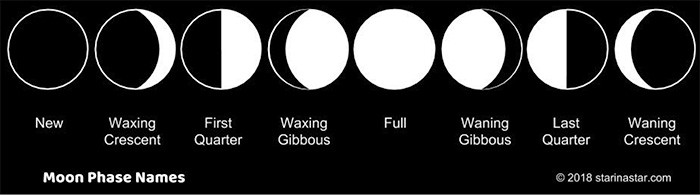
The full moon is one of the most captivating sights in the night sky. It occurs when the Moon is directly behind the Earth and Sun, thus appearing fully illuminated from Earth. This becomes the peak time to view the flat features of the Moon such as the marias, which were seas of lava that cooled off after millions of years. On the other hand, the lack of shadows on the Moon during this time downplay the heights of the craters and mountain ranges, lessening their beauty. The full moon has been used by ancient cultures as a means to track patterns in animals and nature. This has resulted in the moon adopting different names for different months according to behaviors seen during that time. For example, the August moon is also called the “Sturgeon Moon” as the North American tribes noticed an abundance of the species during August. Similarly, the September moon is called the “Harvest Moon” and the October moon is named the “Hunter’s Moon”. A supermoon appears in the sky when the Moon is full and at its closest point to Earth, thus appearing a little larger than a normal full moon. After the full moon, the illuminated area decreases in size during the waning phases and will eventually return to a new moon to repeat the entire lunar cycle.
The lunar cycle has remained the same over many centuries. It has played a crucial role in cultures and civilizations as many used the motions of the Moon to understand the world around them. The constancy of the lunar cycle brought comfort and familiarity to people as they looked up into the night sky. It is a reminder that although the universe appears to be a strange void, we simply need to experience it over time to consider it a part of our neighbourhood.