
Submitted by Nora Dean and John Currie
For almost 200 years men, and quite recently women, have been sailing the waters around Tobermory. In the early years, commercial fishing around the northern part of The Peninsula was the main reason for being on the water. When parts of The Peninsula were opened up for individuals and companies to buy land in the 1870’s, lumbering became the second reason for an increase in the numbers of boats being in Tobermory’s harbours.
There are pictures in Hewers of the Forests, Fishers of the Lakes showing several fishing companies and various lumber mills situated around the Little Tub over the early years. Tourist boats started to appear in the Little Tub in the 1930’s and 40’s. In recent years, tourism has become the main reason for the commercial boats here.

Whatever the reason, early sailers ventured forth on the waters, learning from their elders how to navigate during the day and night, how to handle the boats in all kinds of weather, how to load their boats to maintain balance and buoyancy, how to read the weather, how to repair and maintain their boats, firstly sailing vessels and then power driven vessels.
Many of these early seamen even learned how to build their own boats. Wooden sailing fishing ships were the predominant commercial vessel to ply the waters around Tobermory in the early days. The first steam tug arrived in Tobermory around 1882 – their numbers increased over the years as the number of sailing vessels decreased.
The skills and body of knowledge learned about seamanship were important and as time passed, they became the basis of government regulations governing those who would work on a boat or assume leadership roles on boats.
Tobermory has produced many personnel who have worked on the water, developed skills and pursued knowledge to assume leadership on their own boat. There have been several who have gone on to work on larger vessels plying the Great Lakes and beyond. And that tradition continues.
One of those who learned while you go and played a significant role locally is Pete Dean.
Pete was born in 1943 at the Red Cross Outpost in Tobermory. Today, this is the white house located next to Shipwreck Lee’s restaurant at the ferry dock. He had various jobs as a young man, from short order cook to carpenter to fishing. He worked for Murray Ransbury on the “Lark” and Jack Edmonstone on the “Gerry S”.
Eventually Pete wanted to be his own master.
He bought a boat, “Drifter II”, rebuilt its superstructure, and started his own company having bought a commercial fishing licence in 1968. In these early days, there were three fish houses in town: Ransbury Bros, Lee Bros and Golden’s. There were many Tobermory boats fishing the waters around The Peninsula at that time: W.W. Ransbury, Lark, North Side, Dyker Lass, Gerry S, Anzac K. and his own, Drifter II.
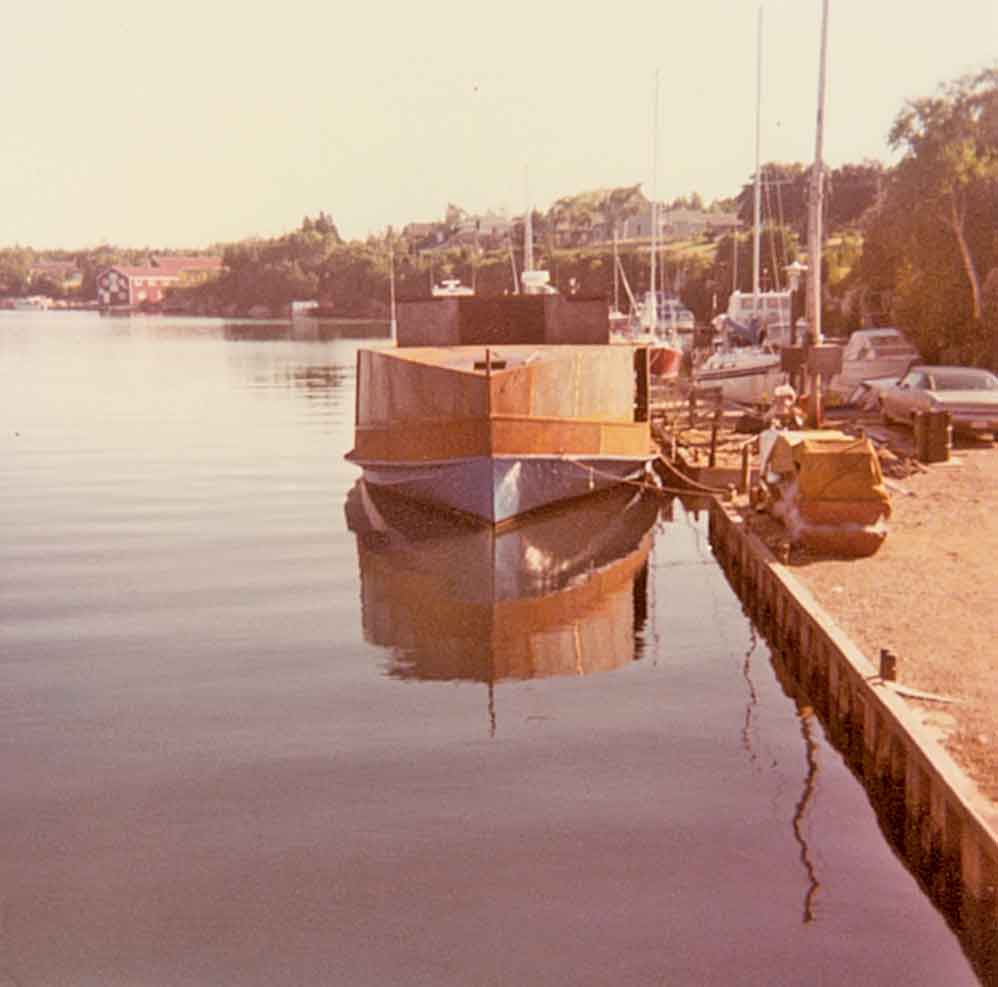
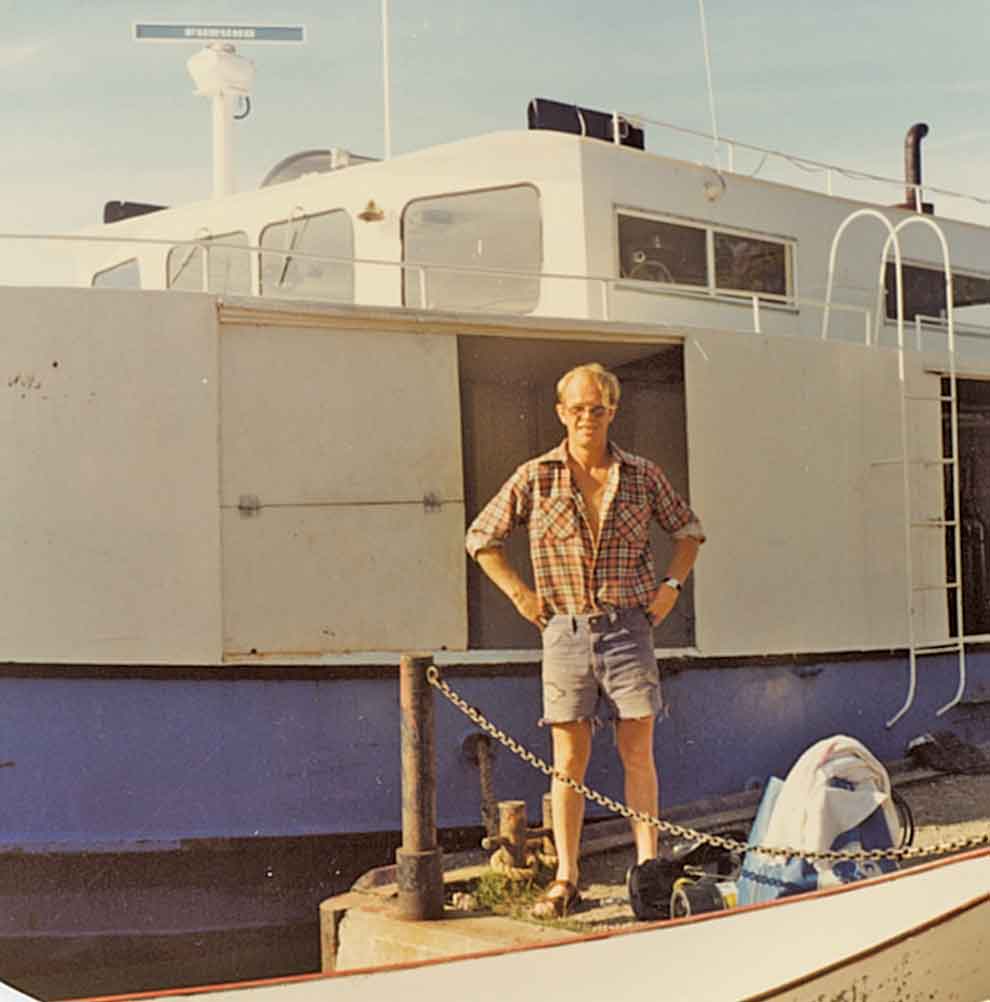
In the 1970’s Pete started to think about building a bigger boat. From his experiences he knew that the bigger the boat, the more stable and safe platform it could be on the water in any condition. In 1978 he started to build his dream boat in the field next to his parents’ house at the corner of Cape Hurd Rd and Hwy 6. It was to be fashioned after the popular turtle-backed model. (Think of the shape of the Mamie, currently at dock in Little Tub Harbour.)
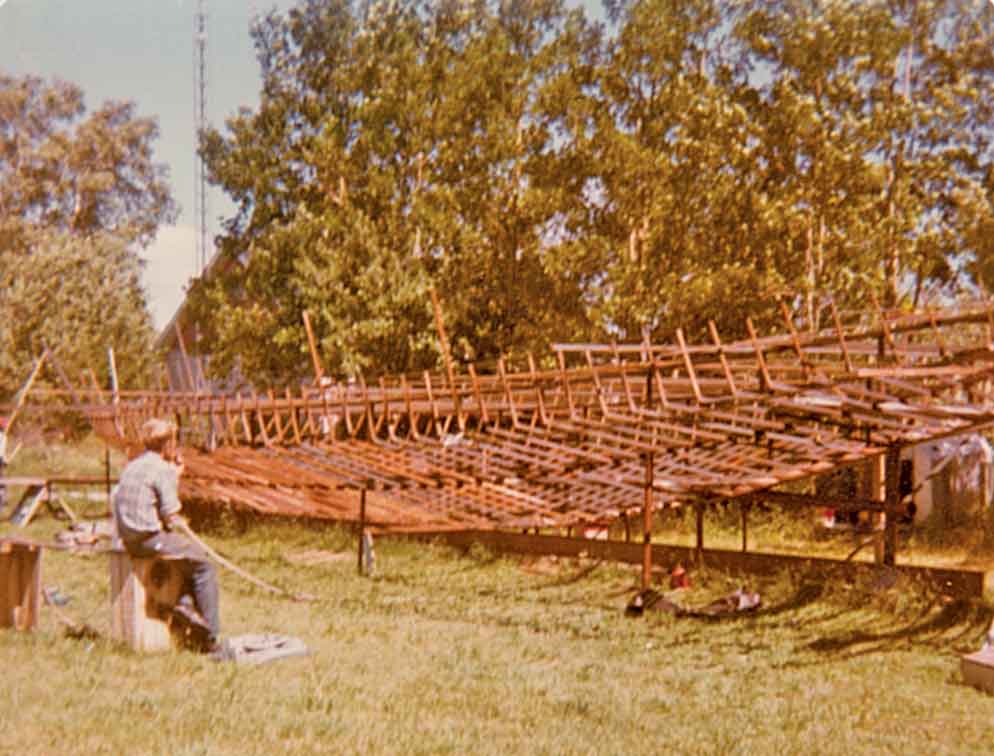
When building a hull, wooden or steel, you start from the bottom and work up. Pete laid an I-beam on blocks and added the frames, ribs and supports. Pete cut the pieces from sheets of steel himself. He installed a rudder and propeller. The bronze and nickel 4 blade propeller was made at the Kennedy foundry in Owen Sound.
When the hull and decking was complete, the hull was towed to the harbour and successfully launched. The hull was 58 ft long and 21 ft wide (17.6 m x 6m). (For a visual reference, the Mamie is approximately 41.5 ft long and 14 ft wide (12.6m x 4.27m).)
At the dock, over the next year, Pete added the 265HP turbo charged diesel engine, the superstructure and pilot house, as well as all navigation and safety equipment. Pete’s work in cutting and fashioning steel became the basis of him starting Tobercraft Welding.
He named the boat to honour his friend, W.A. Spears, the retired Cove Island lighthouse keeper. Bill helped Pete build the boat and only when the boat was christened did Bill find out his name would appear on its bow.
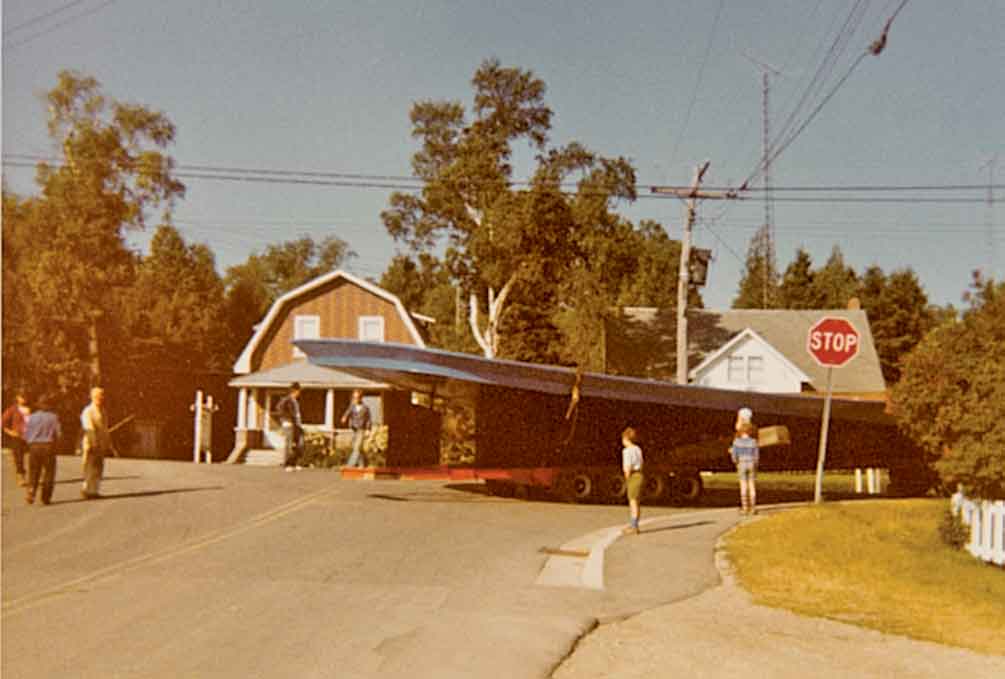
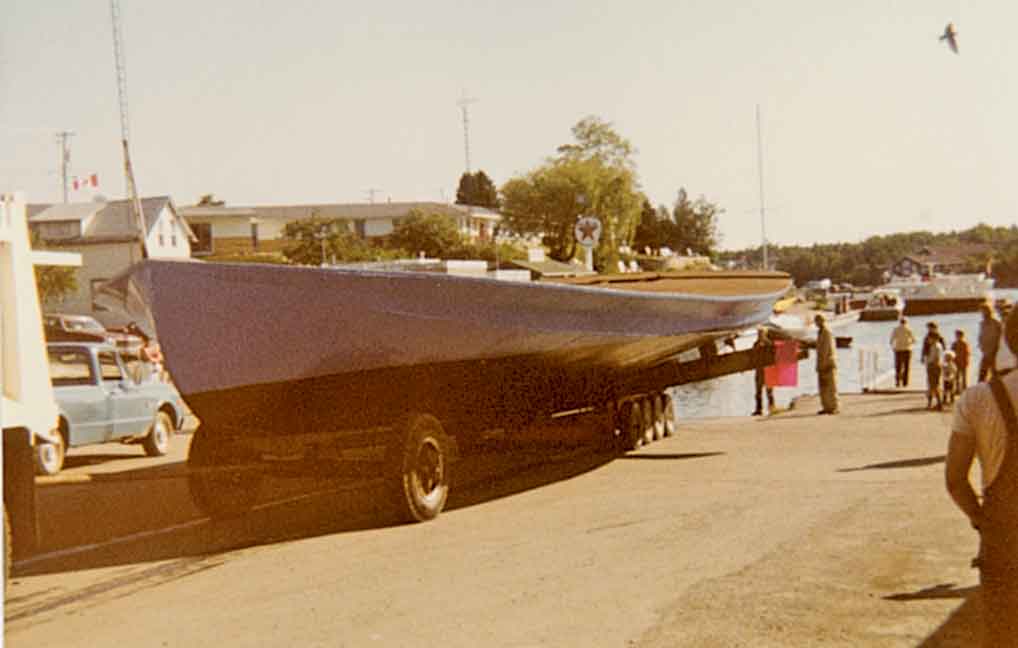
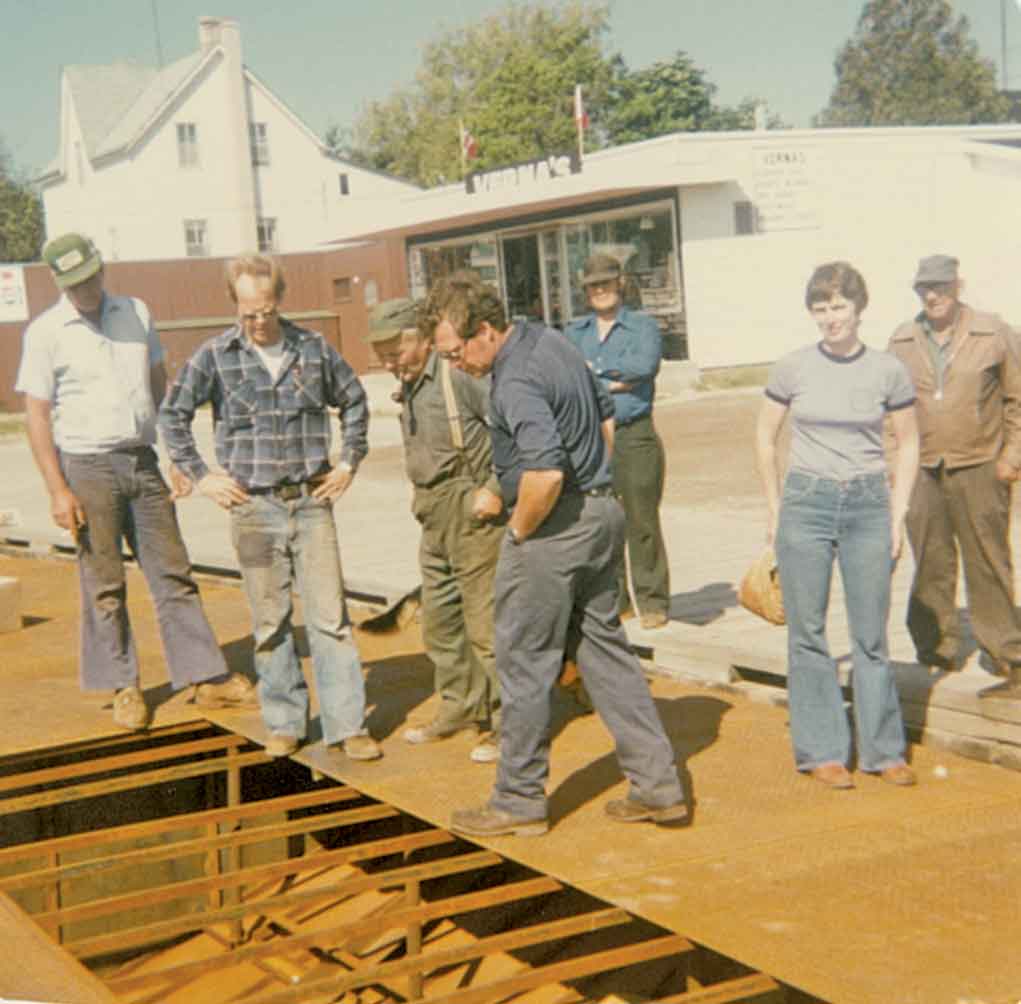
Pete started fishing with “The Spears” in the Fall of 1979. He had three crew: Rod Anderson, Jim Dilworth and Patrick Ryan. They fished Lake Huron as far south as Stokes Bay and north to Manitoulin Island and in Georgian Bay south to Dyers Bay. The main catch was Whitefish.
He sold most of his catch to Ransbury Bros fish house, next to the ferry dock. He later sold fish to Lougheed’s in Owen Sound. Commercial fishing began each year as soon as the ice started to break up in the Spring, and would go into November or early December. Boats would leave the docks usually before dawn when the wind was down. They would return with whatever they caught between 3 and 5 PM. The length of the day depended on where they fished and weather conditions, as well as how many fish they had to clear from the nets and then clean.
Of course, nets had to be reset for the next day, either in the same location or one that might prove more promising than that day. Marking where your nets were set, often out of sight of land, and to return to them the next day, was done well before GPS existed. Dead reckoning is a skill not practised today.
Commercial fishing came to an end for the Tobermory fishermen in 1993 -1995 when the Federal Government bought back their licences and gave the indigenous fishermen the sole right to commercially fish around the Bruce Peninsula. Many boat owners sold their fishing boats to whomever.
Two fishing boats remained in town: the Dyker Lass and the W.A. Spears. The Mamie was here in 1979 but had been used solely for diving by the G&S Dive Shop. Pete used The Spears to take out scuba divers for G&S as well and for private fishing parties before and after his licence was revoked.
Throughout Pete’s career on the water he did a number of different things. He planted splake fingerlings for years for the Ministry of Natural Resources and the Wiarton Sportsmen Club. He took Lighthouse Keepers to and from their islands for years: Bill Spears to Cove, Audrey Coultis to Flowerpot and John Adams to Lonely.
On one occasion Pete took the Spears to Toronto from where he towed a tugboat that had been based in Montreal to Penetang.
On August 27, 1990, The Spears towed the Caroline Rose from Owen Sound to Driftwood Cove. The Rose, built in 1940, was a sister ship of the famous Canadian Grand Banks fishing vessel, the Bluenose, built in the same shipyard in Lunenburg, Nova Scotia. The Rose had become ill-used over the years since the Grand Banks fishery went downhill in the 1950s. It had even sunk at the docks in Owen Sound where it had been used for a few charters. The Tobermory Maritime Association bought the boat after getting permission to sink it in Driftwood Cove as a dive site.
In 2007 Pete sold The Spears to a fisherman in Killarney. It was no longer a profitable boat for him. Today it is on the shore in that area, starting to look like the Anzac K.
Pete very much believed in “The Law of the Sea”: help fellow mariners when they are in need. For 35 years he was a member of the Coast Guard Auxiliary, responding to many calls to tow boats that had run out of fuel, or pull them off rocks, or find them in the fog.
On one occasion, Pete and crew happened to be on the scene when a boat became imperilled. On October 30, 1980 the Spears was fishing in Lake Huron to the West of the Cape Hurd Light. As can happen, the West wind unexpectedly increased to near gale conditions such that it became dangerous to be lifting nets. (Gale winds are classified as starting at 35 knots, or 65 kph or 40 mph. The waves in the 30-35 knot winds in open water could be 6 to 10 feet in height (2-3 m)).
Water was coming in the open door on the port side where the net puller was located. They had to abandon the nets and head back to town. As they approached the entrance to Cape Hurd channel they came across the Avalon Voyager. The Voyager was being moved from Kincardine to Owen Sound when it too was pounded by the waves as it approached Cape Hurd. Its engine became overheated and the boat had to drop anchor at the entrance to the channel.
The Spears came along side the heavily rolling Voyager and rescued the captain and 6 crew. The Voyager’s anchor eventually broke free and the boat drifted thru the channel until it became hard aground off Bonnet Island at the entrance to Hay Bay.
For this action, Pete, Rod, Jim and Patrick were awarded the Medal of Bravery by the Governor General at a ceremony in Rideau Hall in April 1982. (See wording of the Governor General’s citation by Googling “Pete Dean and the rescue of the crew from the Avalon Voyager”.)
On land, Pete has been civic-minded over the years. He was a founding member and second President of the Tobermory Health Clinic Auxiliary. He is still a member. He was the St Edmunds Township Rep on the Board and then Chair of the Wiarton Hospital Board of Directors. He helped organize the neighbourhood Watch Program in St Edmunds Township. He also served on Council for St Edmunds.
Pete Dean: one of many mariners in our evolving maritime history.