


Tessa Swanton (Townson),
Bruce Peninsula Press
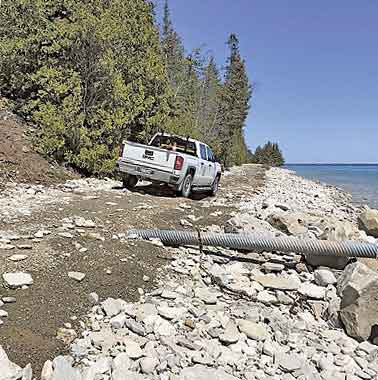
A lengthy discussion on June 8th at the Municipality of Northern Bruce Peninsula (MNBP) Council table again resulted in no firm direction for the future of Cabot Head Road, which remains closed due to unsafe conditions. However, councillors used this opportunity to voice their opinions regarding road access.
In November 2025, Council endorsed a draft Operational Plan prepared by Chief Administrative Officer (CAO), Peggy Van Mierlo-West, describing a combined hiking/biking trail and restricted vehicle access for specific groups/users. The resolution states the plan will be used as “a conceptual framework only, with the understanding that it will be refined following the completion of public, stakeholder, and partner engagement.”

Councillor Laurie (Smokey) Golden explained that Council needs to consider broader long-term ramifications and the needs of residents and visitors. “A lot of what we are talking about belongs to the people of Canada,” she said. “I’m not advocating for open access, just trying to give the most people the opportunity to experience history in one of nature’s most spectacular areas while protecting it.” She noted that Municipal Accommodation Tax (MAT) funds could partially fund the project.
“I would support the combined model,” stated Mayor Milt McIver, referring to the proposed hiking/biking trail with restricted vehicle access. “Vehicles, cyclists, and hikers don’t really mix well together, maybe we can restrict times if we go to a combined model,” he suggested. The mayor referenced concerns with gate security, cellphone service in case of an emergency, and parking within the community of Dyers Bay. He emphasized that the Dyers Bay community is his first consideration.
Deputy Mayor Rod Anderson suggested incorporating a hiking/biking trail with cooperation from Bruce Trail who could supply a parking lot and access to avoid impacting Dyers Bay residents. Rather than spending money to make Cabot Head Road fully accessible, the Deputy Mayor suggested improving accessibility within the villages of Tobermory and Lion’s Head to construct accessible washrooms and sidewalks/paths. “If we’re going to spend money on a road, let’s spend money on roads people use and want repaired or upgraded,” he said.
Councillor Aman Sohrab showed support for a combined hiking/biking trail based on results from the public survey with almost 1,000 respondents. “I’m sure in the future we could find ways to address accessibility,” said the councillor, such as a shuttle service or permitting vehicle access in the off season. He described constructing a hiking/biking trail as the “most reasonable approach” to “prevent overloading that little hamlet [Dyers Bay] with cars and garbage;” and avoid hiring significant by-law staff and developing infrastructure for Cabot Head to be a “full-blown tourist attraction.”
Councillor Todd Dowd expressed, “Maybe we can’t financially support a road, and it automatically becomes a hiking trail for that reason.” He cited concern with increased hikers/bikers causing issues on Dyers Bay Road and people driving to the Cabot Head Road gate assuming parking is available to shorten their hiking distance. He recommended reconstructing the road to a drivable standard so the Municipality can consider allowing vehicle access in the future, in some capacity.
A decision of this magnitude requires careful consideration of cultural, historical, and financial implications. Is accessing Cabot Head a right or a privilege? Should everyone be able to visit the destination regardless of physical limitations? How much is Council willing to spend?
A quote from Deputy Mayor Anderson accurately reflects the complexity of the project, “The more I get into this, the more complicated it becomes.”
Council directed staff to bring back a report outlining levels of service and access, legal rights, and a detailed cost analysis.
MNBP Expects to Collect $255,000 in Municipal Accommodation Tax in 2026
A report from Treasurer, Teresa Shearer, indicated that the Municipal Accommodation Tax (MAT) reserve balance was $291,000 at the end of 2025, with another $255,000 expected to be collected this year. Ten projects were listed totaling $306,100 that will be funded fully or partially through MAT. MNBP also makes MAT payments to the Tobermory Chamber of Commerce with $308,055.53 paid in 2025. The Chamber receives 50% net revenues for tourism promotion and development. In Ontario, is it standard practice for municipalities to give half of MAT to a non-profit tourism entity.
Funds for short-term accommodations (STAs) are collected through licensing and inspection fees. A report from the Treasurer revealed a $238,000 STA reserve balance at the end of 2025 and $408,000 expected by 2026 year end. This collection ensures the STA program is funded by STA owners not general taxpayers.
Councillor Dowd Inquires About Permitting Poultry on Residential Lots
Councillor Dowd asked staff to investigate allowing hens on residential lots. Currently, the MNBP Zoning By-law restricts poultry to rural areas.
Neighbouring town, South Bruce Peninsula, amended their Zoning By-law in 2025 permitting backyard poultry on residential lots with an existing house. Stipulations include no roosters, waterfowl or birds; no sale of poultry/poultry products; and enclosure limits of 10 square metres and 3 metres high.
Nearby Township of Georgian Bluffs permits backyard poultry in residential areas following adoption of a Poultry By-law in 2024. The by-law outlines rules including a maximum of six hens and no roosters, a property owner must live on the land, chickens and hens are for personal use only (not for sale), and no home slaughtering. Coop and enclosure specifications are also listed to ensure safety of chickens and appropriate distance from neighbours.
The township explains that backyard chickens offer several benefits like supplying fresh eggs, pest control, natural fertilizer for gardens, educational opportunities for teaching children, and building a sense of community though sharing eggs and knowledge.