




Tessa Swanton (Townson),
Bruce Peninsula Press
The Municipality of Northern Bruce Peninsula (MNBP) Council approved the purchase of a secondary waste truck for $245,033 plus HST at their September 14 Council Meeting. The truck is a 8 Cubic Yard New Way Diamondback rear loading refuse unit mounted on a 2026 Ford F-600, purchased from Joe Johnson Equipment.
A report from Troy Cameron, Public Works Manager, stated that staff believe purchasing a new backup garbage truck is the most effective way to support municipal waste collection, planned to start later this fall; and Council agreed.

Cameron’s report referred to a Residential Waste Curbside Collection Study that recommended the purchase of a new primary waste collection truck.
Staff proceeded to acquire the first truck for $318,000 plus HST following approval on July 27 from Council. The study also suggested a backup garbage truck in case the primary truck faces mechanical issues or maintenance requirements.
The report reads that staff investigated purchasing a used larger garbage truck for $200-250,000. As an alternative, staff researched a new smaller four-wheel drive truck that “may provide greater operational flexibility and long-term value.”
“Through investigations we found that this smaller truck would be more versatile and we could use it for a lot of our smaller more narrow cottage style roads,” Cameron said. He mentioned the smaller secondary truck could be used often during winter as less garbage is placed curbside when seasonal residents travel home, resulting in fuel cost savings and increased maneuverability.
Councillor Todd Dowd commented that he had “sticker shock” when he first read [the report]. He asked if a curbside attachment could be bought for an existing roll-on roll-off truck or staff could operate a one-ton truck with racks as the backup garbage truck instead. Cameron confirmed that no attachments are available and although a one-ton truck was used in Lindsay Township prior to amalgamation in 1999, it would not be able to accommodate the increased garbage volume of today’s population; coupled with the health and safety implications of workers attempting to repeatedly throw garbage to the front of the truck.
Councillor Dowd requested that “Be Bear Wise” advertising be placed on municipal garbage trucks to inform the public about the importance of securing bear attractants like food, garbage, and bird feeders.
Mayor McIver Supports Development on Chi Sin Tib Dek Road
Laura Swanson, Darryl M. Robins Consulting Inc., made a delegation to Council regarding a concerning comment from Bruce County pertaining to a development application in Tobermory on Chi Sin Tib Dek Road, which states that the County does not support partial servicing for new development proposals. The County’s comment raises questions as to whether development opportunities would be restricted throughout the Municipality – Tobermory only has sanitary sewer available, and Lion’s Head only has municipal water services.
Swanson, working on behalf of Churchill Development, said the application proposes to develop a 56-acre property to a residential subdivision and campground. The property is 240 metres from the municipal sanitary sewer and there is currently no municipal water service in Tobermory. The owner plans to connect to the sanitary sewer and temporarily provide wells until water servicing becomes available in Tobermory.
“We wish to highlight that Tobermory and Lion’s Head are both communities that are predominantly on partial services,” stated Swanson. She explained that she believes the County’s policies are focused on guiding urban centres like Port Elgin where both services (water and sewer) are present, not smaller villages offering partial services. “This policy restricts the development opportunities in the Municipality of Northern Bruce Peninsula,” she said.
Although the County’s Official Plan restricts development in partial service areas, Swanson noted that the Provincial Policy Statement does say that municipal water and sewer services are the preferred form of servicing in settlement areas from an environmental and health and safety perspective.
Developer Cal Churchill asked for the Municipality’s support for the application despite the County’s restrictions. Mayor Milt McIver responded that “If we don’t [support partial service developments], we’re never going to have any development occur and we do want some housing to be built…I didn’t think provincial policy was that tight, I thought there was a little bit of flexibility.”
The mayor directed staff to contact the County expressing the Municipality’s support for the application and offered to speak directly to the County Planning Director.
“We got a cost estimate of 80 million to put water in Tobermory, so unless the government supports us for 90% of it, it’s going to be pretty hard to afford,” expressed the mayor.
Council Approves Road Realignment Reconstruction Option for Tammy’s Cove Road for Almost 1.5 million Dollars
Road realignment and direct access (Option 1) was approved by Council as a reconstruction option for Tammy’s Cove Road on Miller Lake. A staff report from the Public Works Manager estimated a capital cost of $1,466,903 plus HST to be considered through a future capital budget process.
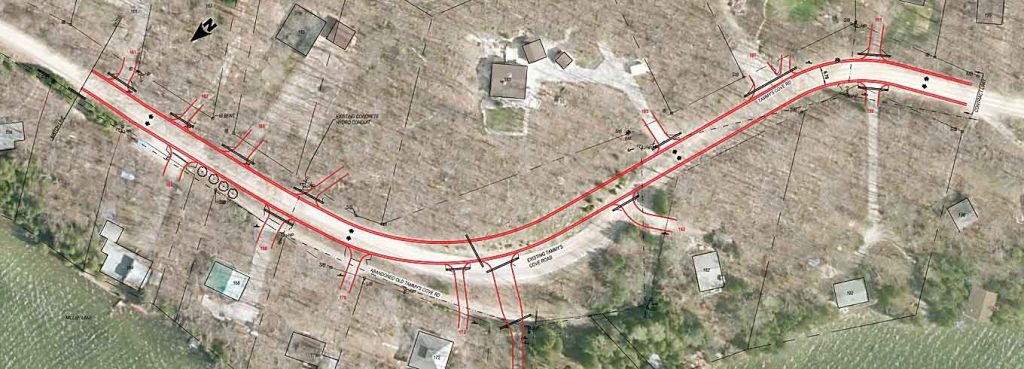
The Municipality’s Roads Needs Study recognized Tammy’s Cove Road as requiring reconstruction and hard surfacing. To plan the project, Darryl M. Robins Consulting Inc. was hired to address the road and collect resident opinions. Findings noted several areas of the road non-compliant with highway standards. Cameron described the angled road as posing a safety hazard.
A survey distributed to 18 residents resulted in seven responses with 49% favouring Option 1: road realignment to the south, lowering some road elevations, elimination of an intersection, and direct driveway access to the new roadway provided to all affected residents. The old Tammy’s Cove Road will be removed. Staff recommended Option 1 to offer a direct route for emergency services and allow winter road maintenance and curbside waste collection.
Two other options were presented to residents. Option 2 was a close second choice for respondents with 46% preferring this similar road realignment approach with a new intersection, narrow lane along the old road, and direct driveway access for one affected property. Only 5% chose Option 3: divided roadway.