



By John Francis
The 2025 Sources of Knowledge (SOK) Forum was held in Tobermory, Oct 24 to 26. The subject was Fire, especially Forest Fire. Speakers talked about fighting fires; they discussed strategies for fireproofing forests and settlements; they talked about how climate change will increase the risks.
Parks Canada’s Sean Liipere talked about “Forest Landscapes and Their Relationship With Fire in Bruce Peninsula National Park”. Forest fire consumed the entire peninsula in the first decade of the twentieth century; most of the area burned down to bald rock. Liipere gave a before-and-after view and talked about how very different the current forests are from those that predated European settlement.

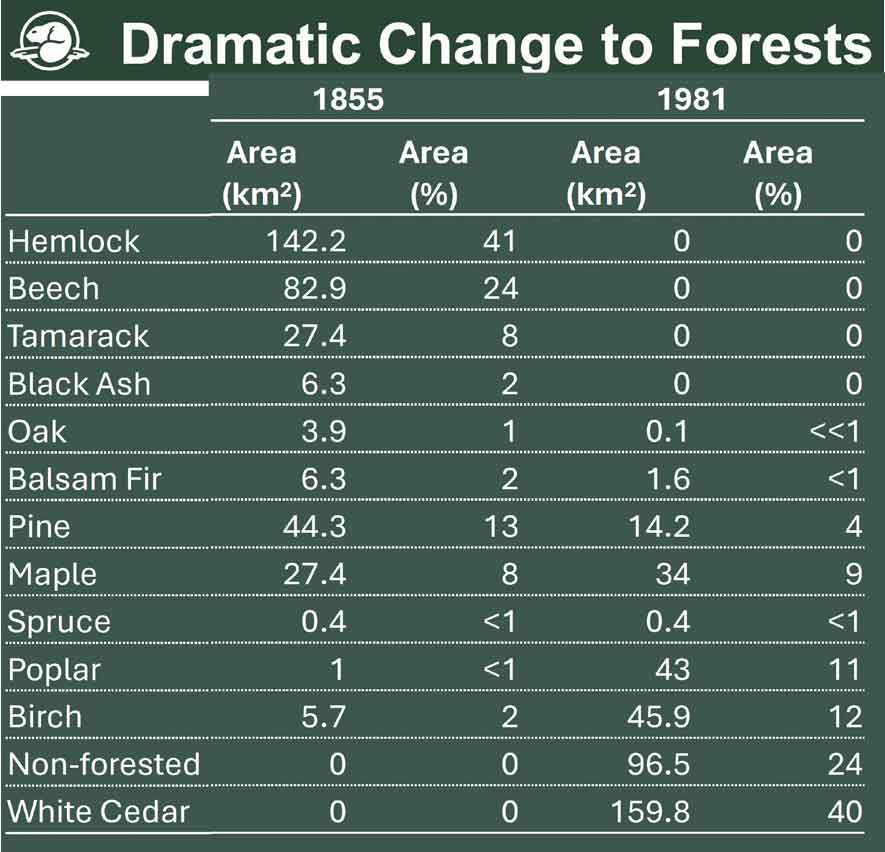
The chart at right is reproduced from his talk. It details the dominant tree species in the forests of the former St Edmunds Township from 1855 and 1981.
In 1855, as now, the species pool of forested areas consisted of about 35 species of trees; then, as now, a few species dominated. But the dominant species have changed wildly.
The most abundant forest tree on the Saugeen Peninsula in 1855 was hemlock. In 2025, you could hike all day and not see a single hemlock tree. The second most abundant tree was beech, followed by pine (all species combined), maple (all species combined) and tamarack.
In 2025, the dominant tree is Eastern White Cedar, which was a minor component until the fires. The next commonest species, poplar (which includes both aspen species) and birch are all characteristic of disturbed sites.
Reclaiming the Old Forest
You know that feeling you get when you’re in a really old forest? The hushed, cathedral feeling, the few shafts of sunlight on the forest floor, the large trunks of the living trees, the forest floor strewn with rotting fallen trees, the spongy feel of a deep bed of organic material underfoot…
Two hundred years ago, the whole Saugeen Peninsula was like that.
“Sylvics of the Forest Trees of the United States” describes hemlock forests: “Hemlocks in groups or stands produce an exceptionally dense canopy. … Beneath a hemlock canopy the microclimate is cooler and there is less evaporation during the growing season than in adjacent hardwood stands of similar age on similar topography.”
The phrase “less evaporation” is important. It means that a hemlock forest is less prone to becoming desiccated during a drought, which dramatically reduces fire risk. (The same is true of cedar forests — their dense canopy keeps the forest floor moist.)
But when settlers and loggers took all the trees, they left piles of leaves and branches in their wake — piles of kindling — with no tree canopy to keep them moist. Catastrophic fire resulted. In most areas, even the organic soil was burned — right down to bald rock.
So what happened to the hemlocks?
Sylvics again: “Hemlock germination and initial survival are most successful on shaded, moist, cool sites. … Favorable seedbeds are moist, well-decomposed litter, rotted wood, mineral soil and moss mats on soil or on rocks”
When the organic soil burned, there was no place left where a hemlock seedling could survive.
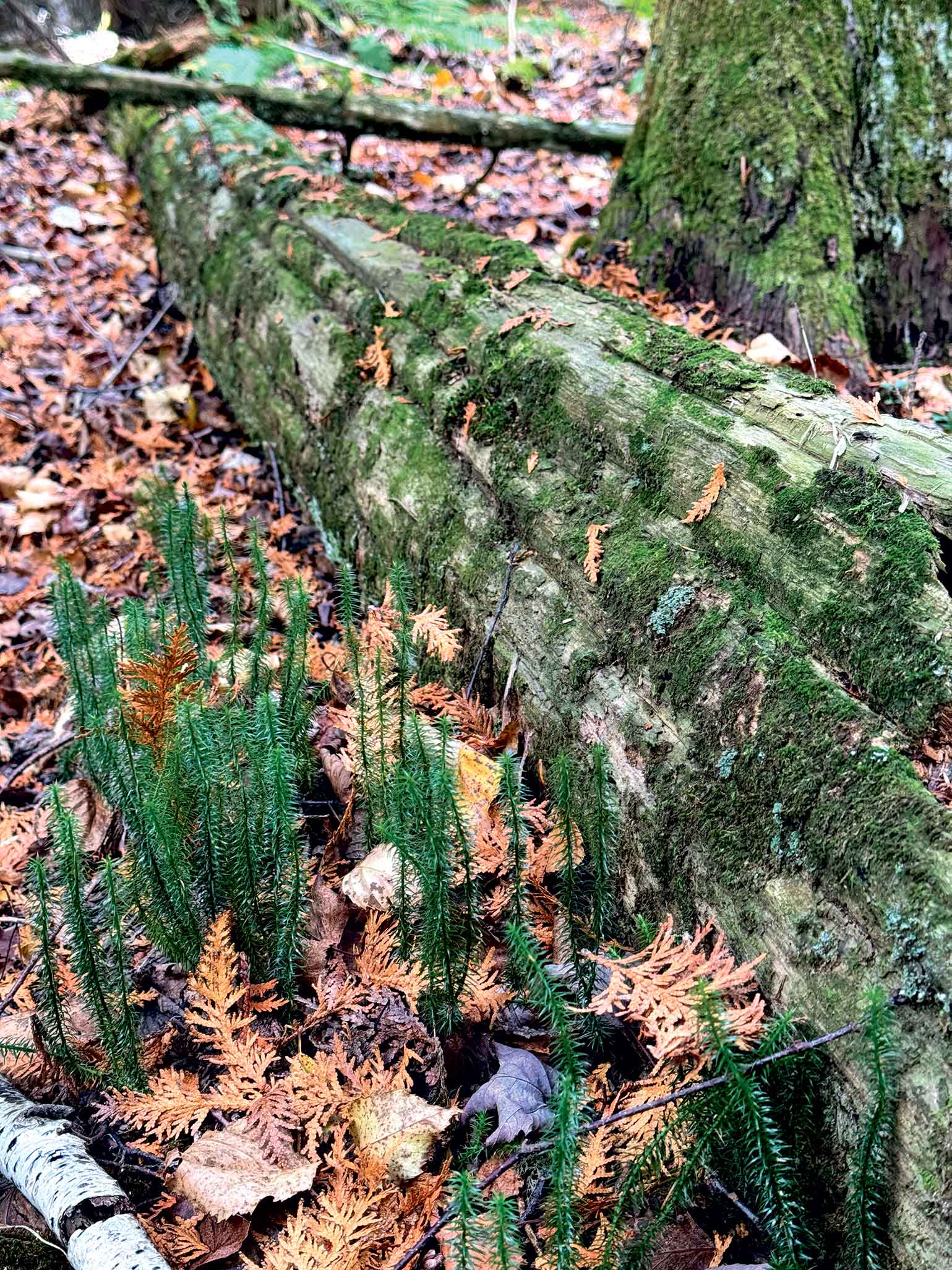
There are a very few places on the peninsula where the fires left the organic soil layer mostly intact. Those are the places you might still find a few hemlocks. (You’ll also find clubmosses and the odd Canada Yew, both of which are also otherwise rare.)
So: do we want to restore our forests to Hemlock and tall, old hardwoods? (I vote for “YES”.)
At SOK, Thomas Heinrich gave a talk about restoring old growth forests. He talked about interventions that can speed up the process. One of the most important elements in an old forest is “nurse logs” — fallen trees rotting on the forest floor, providing nutrients and a moist, mossy bed where tree seedlings have a better chance of surviving.
Heinrich talked about the importance of “disturbance” in restoring forests — creating artificial nurse logs and making openings in the canopy.
Do we want to make an effort to restore peninsula forests to their former glory?
Over to you, gentle reader…