


Men’s Breakfast July 12th Meeting
Submitted by Daryl Cowell
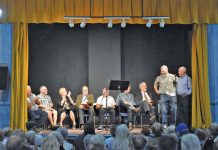
Mike Warkentin is the Dark Skies Chair on the Bruce Peninsula Biosphere Association’s Board. At the July 12th Men’s Breakfast meeting, Mike brought along a couple of high-powered telescopes to help illustrate his talk on how we are gradually losing sight of our night skies and the amazing array of stars and constellations.

Mike is a retired software engineer for IBM Midrange computers, having worked with companies like Manulife Insurance, GE Canada, and IBM Canada in a variety of roles. His passion for astronomy and dark skies began when he watched the Apollo 11 landing, and built his own telescope at age 13. He promotes dark skies on the Saugeen/Bruce Peninsula, running the annual Bayside Astronomy program. He lives in Mississauga but spends a lot of time at his home in Greenough Harbour.
Mike’s presentation focused on how light pollution is hiding our night skies and what we can do to help. He described 3 types of light pollution including “Sky Glow” such as the dome of light often observed over cities; “Glare” such as direct light coming from advancing headlights; and “Light Trespass” whereby brightly lit buildings invade the privacy of neighbours. We remain fortunate here on the northern Saugeen Bruce Peninsula with great night sky views, in part due to our municipality’s designation as a Dark Sky Community. In contrast, Toronto’s skies are approximately 9 times more obscured where only the moon is regularly clearly visible. We still have some of the darkest skies in North America. Interestingly only about 20% of the world’s population can still view the Milky Way.
Light pollution continues to advance at a rate of 9.6%/year. In addition to losing direct views, this has ecological impacts. It impacts turtle nesting as newly hatched turtles follow the brightest light available (normally the moon and stars) in order to find their way toward ponds, lakes and oceans. Birds get confused by bright lights at nights causing them to mortally impact buildings. Approximately 35 million birds/year in North America are killed from impacting buildings at night. Fireflies can still be seen on the northern peninsula, but their populations are massively declining as they use the Milky Way to navigate, but are re-directed by bright lights. We can all see the effect of this on moths – our headlights attract them as we drive home. Even trees are affected, as they bud earlier and loose their leaves sooner. Light pollution also affects human health by interrupting our circadian rhythm and can contribute to breast cancer.
We can all contribute to reducing light pollution by ensuring outdoor lights around our homes and cottages are useful (only if needed); targeted (only where needed); kept at a low level; controlled to be lit only when needed (use timers, motion sensors, etc.); and utilize warm colours. When purchasing light fixtures, look for rating between 2700 and 3000 k as shown on the packaging.
The next Men’s Breakfast will be held on August 9th. Speaker TBD. Please contact Steve at mensbreakfastnsbp@gmail.com if you are planning to attend.