

By Hazel Smith, Bruce Peninsula Press
I have made a date with brothers Danny and Bradley Wyonch to meet for tea and to look at old family photographs.
The brothers are 5th generation members of a very prominent Settlement family with roots extending back to the original cohort of Tobermory colonial families. They are third generation on the Wyonch side and fifth generation on the Hopkins side. The Wyonchs, prior to arrival in St Edmunds, were settled not far away in the Cape Chin area.

On a sunny day in late May I am greeted at the door by two men whom I have not seen in many years, and who, like me, have begun to grow old – all of us various degrees into our 60s. Their welcome is gentle and immediate, “Come in, come in. No, don’t take off your shoes.”
We talk about the perhaps old-fashioned politeness of removing shoes and wonder how much it is done anymore. They reminisce with fondness about their mother, Gloria, who protected her clean floors with a shoe removal regime.

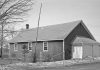
I search their faces for hints of the boys I knew long ago as we shared classrooms in the old Tobermory three-room schoolhouse (that sat where the tennis courts now are); search for remnants of the sleep-traced faces that clambered aboard the big yellow school bus. No doubt they search my face for a sign of the girl I once was.
We proceed directly to the kitchen. The kettle is put on and decaf tea is suggested, it is 2 o’clock after all, and they are protective of my sleep.
We spend the first hour reestablishing commonalities. A love of Tobermory. Mutual hermit tendencies. Dietary choices. A desire to be on good terms with all our neighbours.

We move on to reminiscences of our parents. I am touched when they recall my father and mother, Albert and Gloria: “They were always good people.” And, further, particular praise, “They were interesting people, always good to talk to, and took an interest back, in us.” I am able to share some fond memories of their father, Levi, from the summers I worked at what was then Cyprus Lake Provincial Park. How he was kind and gentle and especially patient and good with the young staff.
While we recognise our commonalities we also recognize our differences. In particular the differences of our childhoods. Namely, they were “country people” and I was “town people”. It is hard to convey how separate our respective worlds were even as late as the 1960s and 70s. Although the “Settlement” school closed in 1966 and we all attended the “Town” school or shared a bus to Lions Head, our lives remained significantly separate.
The “Settlement” (aka “Country”) was essentially a separate community and consisted of the area south of the village, including the 5 Mile Block, as far as the southern boundary of the township. People who lived there were referred to as “country” people by those of us who lived in the village.
A few years ago a visiting friend suggested we go to a beach in Lindsay Township, “You’ll know the one I mean.” Au contraire, I corrected. When I was growing up in Tobermory, Lindsay Township was like a foreign country. In fact, for a ‘town girl’, almost anything south of the Cape Hurd Road was a foreign country. Visits to relatives “in the Country” were exotic outings.
Despite the separateness, it emerges how essentially alike were our fathers’ lives. Their Dad turned his hand to a bit of mixed farming, mine to a bit of commercial fishing. Levi cut Christmas trees, cut brush, cut posts, did part time snow ploughing, drove a delivery truck, all the kind of things my own father turned his hand to as needed. Both men could “fix anything” and were jointly involved in the 1960s bush clearing that created the Cyprus Lake Provincial Park. Our mothers, besides both rearing a brood of closely spaced children, had the distinction of sharing a comparatively unusual first name.

The Wyonch surname is unusual to the point of rare. Except here in Tobermory, I’ve encountered it nowhere. Bradley and Danny have heard a couple of accounts for the history of the name. One being that it is a variant of the German “Wünch”. Another being that it is a variant of the English surname “Wynche”. Recent DNA results from a couple of immediate family members bear out the latter theory. DNA results point clearly to origins in Wales, Ireland, and Scotland, with no German markers.
Later, a quick google search confirms how rare indeed is their surname.
“The last name is primarily found in The Americas, where 100 percent of Wyonch live; 100 percent in North America and 100 percent in Anglo-North America”. The name is most frequent in Canada, particularly Ontario “where 86% are found.” (forebears.io/surnames/wyonch)
Danny and Bradly are grandsons of the legendary Lottie Wyonch (nee Hopkins). A woman immortalised in the series of paintings by Allan Smutylo and widely respected and admired for her stamina and immeasurable work ethic. Their father, Levi, was the sixth of her 11 children.
In the series of photos included you can see Lottie and Charlie Wyonch with all 11 children. Levi, the boys’ father, is kneeling on the far left, poised to deliver a knockout. In another photo an elderly Levi c. 1980 is pictured during an outing with son, Ernie, standing next to the remains of his father, Charlie Wyonch’s, bush shanty near the William Henry Marsh.


Also pictured is Charlie and Lottie’s early 20th century log house (c. 1922) near the Georgian Bay shoreline at what was once known as Cooney’s Dump. “Dump” in this context refers to a “log dump”, like Simpson’s Dump and Halfway Log Dump.
Remnants of the early Settlement community abound on their property. Not surprisingly, as the property, according to land records, was considered an “active farm” as early as 1878.
A truly beautiful example of a 19th century root cellar still stands, in remarkably fine condition, and was in active use until very recently.


A door in their woodworking shop is made of 16” milled boards cut in the heyday of the timbering era and milled locally.
A carved sign, “J.G. Martin Tob Nov 24 1901”, is preserved in their present day workshop. It was originally affixed to a blacksmith shop where the Highway Market later stood, just south of The Coach House Inn. In pioneering spirit the blacksmith shop was salvaged by an earlier owner of the farm who incorporated it into the barn that stood on the property until very recently.
An old highway sign for the Kings Highway is finally ready for reuse.
And in true old-Tobermory fashion, well into our re-acquaintance, as we wade back into our family trees, the most amazing fact of all emerges. We are, lo and behold, distant cousins! I can only smile, of course we are!