



Submitted by Jacqui Wakefield on behalf of the MNBP Waste Management and Diversion Group
Given where we live, many of us place orders for hard-to-find items. Unfortunately, getting packages shipped to our homes creates all kinds of special types of packaging waste.

How much of this stuff can be recycled?
Some items are easy. For example, recycling cardboard boxes is straightforward. Break them down, flatten them and put them in the recycling bin. Be sure to keep them clean and dry. Please do not recycle moldy, greasy or food-stained cardboard, as that can contaminate an entire load. Likewise, any cardboard that seems to be lined or coated with a waxy or plastic-y substance (like a frozen food box) should not be recycled.
However, other materials are harder. Shipping bags are often made of plastic or lined with plastic or bubble wrap. These, like any other type of mixed materials, cannot be recycled. Air pillows and bubble wrap can only be recycled in communities that have recycling facilities for grocery bags, so not in the Municipality Northern Bruce Peninsula (MNBP). The good news is that they can be reused again and again!
Did you know that the MNBP has a program to recycle Expanded Polystyrene Foam (EPS) packaging?
This is a bit of good news in recycling packaging! You most commonly see this type of foam packaging if you receive electronics, small appliances or anything else that needs sturdy molded packaging to ship. It is white and light-weight, but it is also bulky and takes up a lot of space.
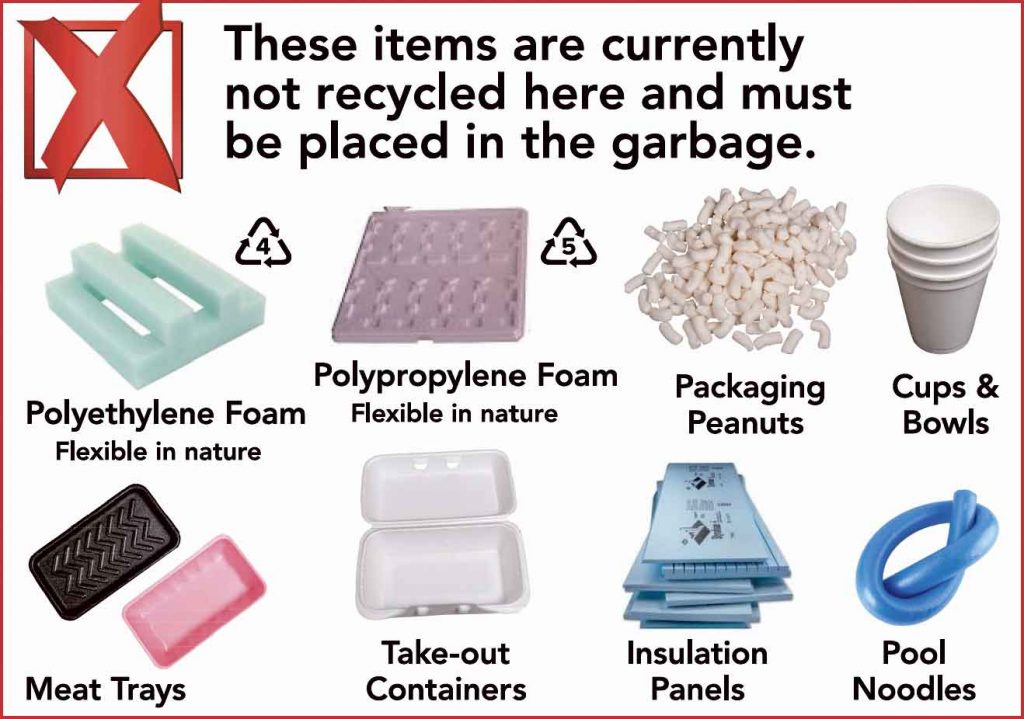
Before taking this material to one of the landfill sites, be sure it is clean and that any tape (clear or coloured) and UPC stickers are removed. Note: Only rigid white foam is accepted. Unfortunately, items like food trays, other packing foams, and packaging peanuts cannot by recycled yet (see photo below).
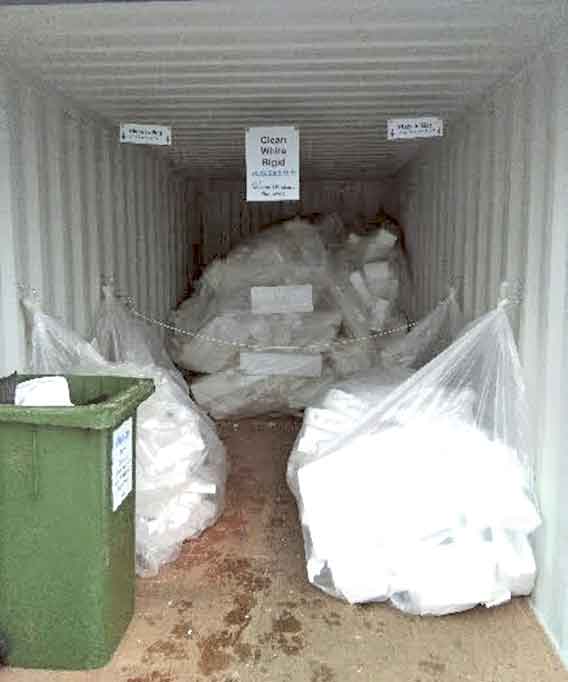
At the landfill sites, the attendant will direct you to a storage area where you can place your packaging material in one of the large clear bags (see photo below).
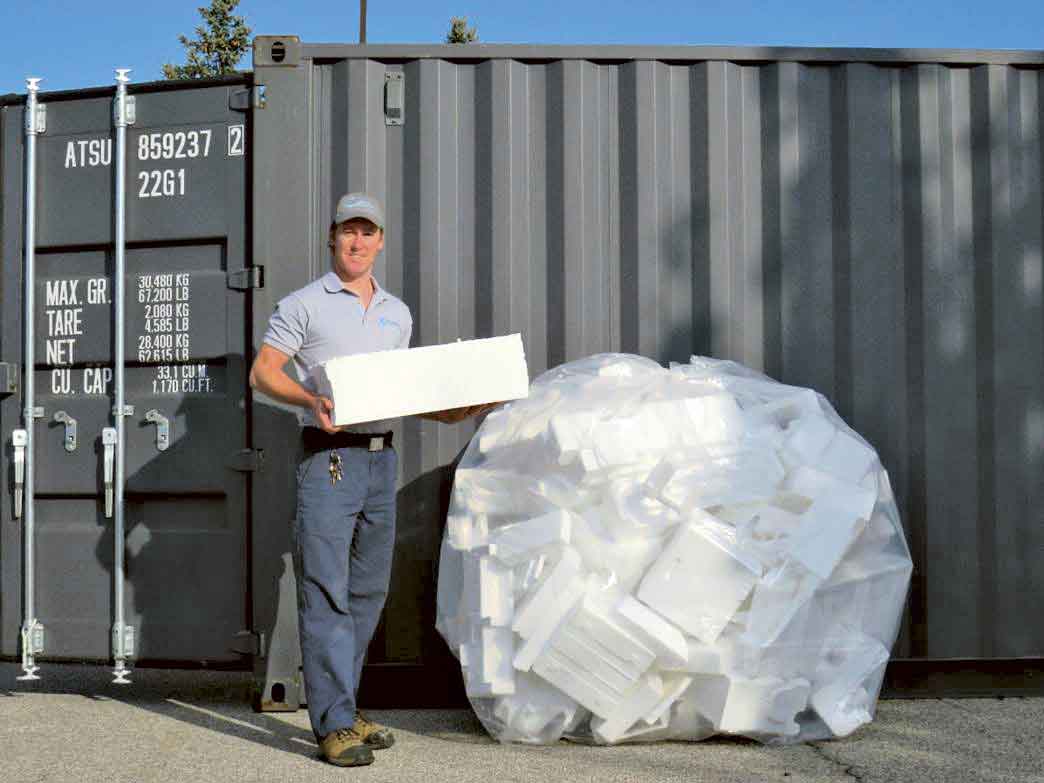
Once enough EPS packaging is collected (usually three times a year for our municipality), a specially equipped truck from Second Wind Recycling arrives to “densify” the foam – making it more compact for transport and more suitable for recycling. At a recent meeting of the MNBP Waste Management and Diversion Group, Dane Rice described the “densification” process, which is the key to effectively recycling this material. It uses a cold compactor to compress/bond the packing material. There is no smell, heat or fumes from the densification process, and it essentially removes all the air in the foam. As the photo shows, the volume of material is dramatically reduced by this process – as Dane is holding a single densified block that is the equivalent of what is in the large clear bag! The reduction ratio is 50:1 and allows the equivalent of up to 2 semi-trailers of loose material to become a single pallet load of densified material!
Currently, Second Wind Recycling has 6 outlets for recycling the densified foam, and these companies make products such as picture frames, moldings, insulation, surf boards, and synthetic lumbers for decks or outdoor benches.
MNBP Public Works Manager Troy Cameron indicated that 99% of polystyrenes are taken to the landfill sites by residential households, and holiday seasons do show an increase in this type of packaging. So, let’s keep doing our part to give EPS a new life and out of our landfills!
Note: If we cannot recycle packaging peanuts, what can we do about them?
There are two types of packing peanuts—polystyrene and cornstarch. Polystyrene packing peanuts, the most common, are often white, pink or green. They do not biodegrade and cannot be recycled, but they can be safely reused over and over for packing material. Some people also have found creative ways to “repurpose” polystyrene packing peanuts, such as filling the space in garden pots if you don’t have enough dirt (they help create good drainage for the pot as well) or letting kids use them for crafts.
Cornstarch packing peanuts are less common and are usually white, light tan or light green in colour. They were developed to be a more environmentally friendly packaging option, as they are biodegradable and nontoxic. Thus, they are not harmful when put in the garbage or compost and will decompose within days.
If you are not sure which type of packaging peanut you have, simply put it in some water. The cornstarch ones will start to dissolve but the polystyrene ones will not be affected.