




The following is an excerpt from the Owen Sound Field Naturalists September Column. Visit osfn.ca for more information on club events.
Submitted by John Dickson

The Owen Sound Field Naturalists (OSFN) club has field trips lined up throughout September, October and November, with such diverse themes as botany, geology, ornithology, old growth forests, and even history.
Trip and membership information are all listed at osfn.ca
OSFN Hold Botany Hike at Black Creek Provincial Park
Barbara Palmer led a botany hike for OSFN recently and shared this report:
On a sunny September morning, a group of plant enthusiasts met at Black Creek Provincial Park for a stroll to observe flowers and plants.
Goldenrods and asters were abundant and colourful. Hairy goldenrod lined the trail in a couple of spots. Asters included calico, smooth, panicled and purple-stemmed. The purple-stemmed asters were particularly showy, with tall, fuzzy stems and lots of purple flowers. Despite its name, this species doesn’t always have purple stems!
Other flowering plants included turtlehead, cardinal flower, small flowered agalinus, and boneset. Many other plants were observed that had previously bloomed, leaving us with seeds or just leaves to notice. Poison ivy kept us on the trail as it was everywhere!
A Massasauga rattlesnake found lounging beside the trail was a highlight. All in all, a good morning of botanizing.
Fall Migration
With the fall migration of birds now underway it is hard to ignore the changes in the weather as flocks of Monarch butterflies are also getting ready to fly to Mexico.
While I was cycling with friends on a road north east of Kemble almost two weeks ago, I was surprised, and delighted, to see about 10 Monarchs fluttering right in front of me, and even more of them along the edge of the adjacent field.
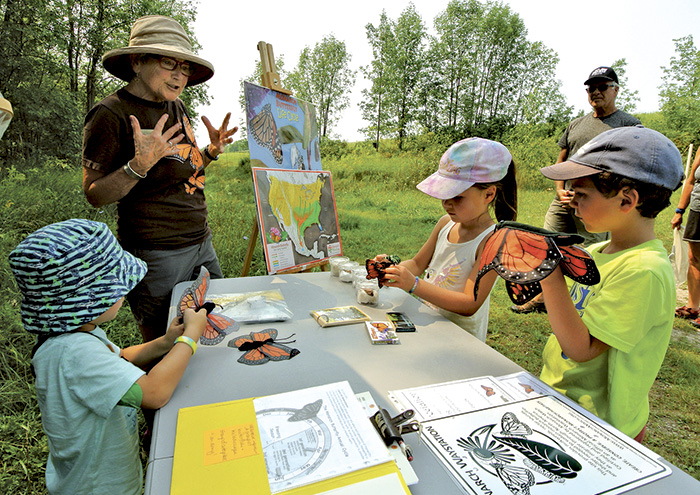
Coincidentally, earlier that morning, on this same stretch of road, also cycling we had met Willy Waterton and Audrey Armstrong, who had held a very successful “Monarch Tagging Workshop August 21 at Isaac Lake.
We had 43 participants over two time slots and two days. With assistance from Brian Robin and Patti Byers, we tagged 69 super generation monarchs as Citizen Scientists for Monarch Watch.
There were 9 family members who came out for a preview day on August 20 when we were astonished at the numbers of nectaring monarchs in the meadow overlooking Isaac Lake. Estimated over 100 monarchs nectaring along with clouded sulphurs and cabbage whites on clover.
We hosted members from OSFN, Saugeen Nature and a few out of town guests. Everyone who participated successfully netted at least one or more monarch. Even the youngest member, aged 4, netted one with a child’s net. The morning of August 21 started early with a radio interview on CBC with Jason de Souza on Fresh Air.
There were lots of big smiles as members said “Adios mariposa” releasing their “tagged” monarchs for the 4,000 km flight to Michoachan, Mexico.
Walking Through a Cloud of Monarchs
Stephane Menu, from the bird observatory (bpbo.ca) at Cabot Head entitled his most recent weekly blog “Walking through a Cloud of Monarchs!”
Here is an excerpt:
“… afterwards, an intense thunderstorm moved through Cabot Head. The sky cleared later in the morning but the wind stayed too strong to open mist nets again. We spent the rest of the day watching mixed flocks of migrants moving through, as well as numerous Monarch butterflies arriving from Georgian Bay in seemingly endless streams.
Bay-breasted Warbler was the most abundant species, with an estimated total of 50 birds, an unheard of number for Cabot Head in any given day in fall (or spring, for that matter). Ten other species of warblers were also detected that morning, albeit in much smaller numbers, with boreal forest specialists like Tennessee, Cape May and Blackburnian Warblers.. On August 29, another storm rolled in during the evening: please check the pictures on Instagram and Facebook.
During these stormy days, dozens and dozens of Monarchs roosted and stayed at Cabot Head in numbers I have rarely seen before. They favoured branches of trees lining the road to the station at the end of our regular net checks.
We were walking through clouds of Monarchs, an orange fluttering of wings, seemingly fragile and insignificant, but actually ready for their incredible migration to the high forests of Oyamel firs in the central highlands of Mexico.
When the contrary winds stopped, when the unsettled air blew away, when dawn came clear on a North wind, they left us, resuming their journey on a wing and a butterfly prayer. Very different from the full view of resplendent plumages in the bare branches of spring.”