


Tessa Swanton (Townson),
Bruce Peninsula Press
Voter turnout for the 2026 Municipal Election in the Municipality of Northern Bruce Peninsula (MNBP) was 33.79% according to official results certified by the clerk. This percentage reflects that only 3,301 of 9,768 eligible voters cast their ballots (23 of whom declined their ballot but are included in the turnout).
Official election results for the 2018 and 2022 elections show voter turnout was 41.11% and 37.3%, respectively. Voter turnout is steadily decreasing in MNBP, term after term.

Some public comments across local social media groups point to eligible voters unaware of the election because they do not actively use technology to receive communications.
Several disgruntled voters complained of not receiving their Voter Information Letter because they were not on the voters list, even though they had been on the list in previous elections.
85% of voters used internet voting compared to 15% of voters who used the telephone, said the clerk. In 2022, 88% used the internet and 12% used the telephone. This data remains steady showing a preference for internet voting, while some electors still favour a telephone to cast their ballot.
Data supplied by the clerk indicates that the highest participation rate in the 2026 election was from voters 70-79 years of age, with 42.66% of eligible voters casting a ballot. Lower participation was observed in the age ranges of 90+, 40-49, 50-59, and 18-29. Interestingly, in 2022, 43.3% of MNBP’s youngest voters cast a ballot (ages 18-24), much higher than this year’s 26.69%.
The data prompts the questions: How do we motivate people to vote? How do we reduce barriers to voting? Political experts say that increasing voter turnout is directly linked to making voters feel more connected and engaged in their community. Some say that the lack of political party affiliation with municipal candidates causes low voting. When candidates are attached to a party, it can be easier to cast a ballot as many already know their stance on major issues. Municipal candidates must clearly communicate their opinions and voters must invest in getting to know them by attending All Candidates Meetings, reading the newspaper, following a candidate’s social media (if they have one), or speaking to them in person – something people may not be willing to spend time doing.
The Association of Municipalities of Ontario (AMO) suggests that holding candidate forums and debates, increasing the number of candidates running for election, and enhancing voter access to information about candidates can strengthen voter interest.
An October 29 article published by AMO presents key findings from the 2026 municipal elections. “Turnout varied considerably among the municipalities,” states the article. Small municipalities with under 10,000 electors averaged a 42% turnout. Women remain underrepresented in municipal leadership, noted AMO, accounting for only 31% of council members. More than 1,100 new councillors were elected and almost half of incumbent mayors were defeated.
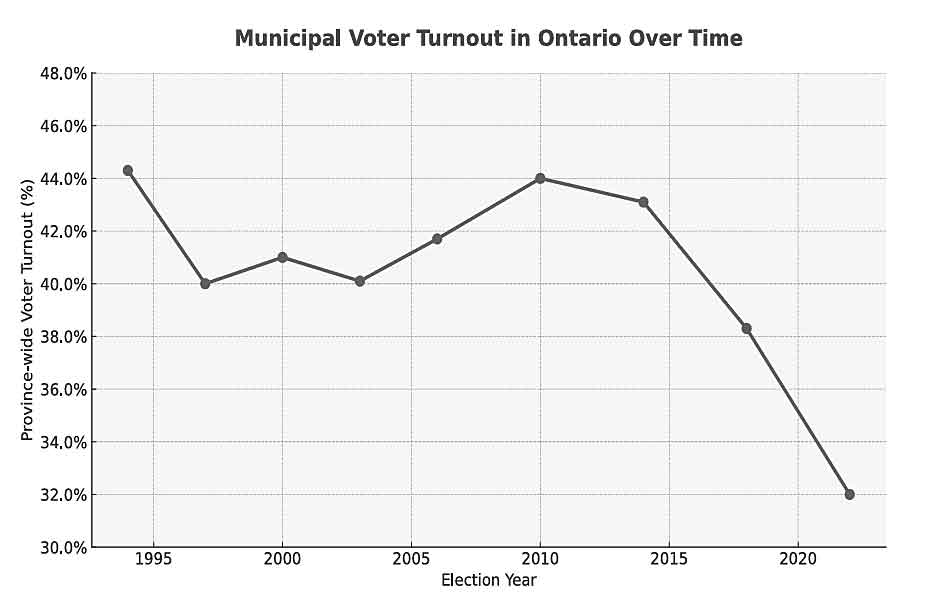
AMO’s website reported a 36% province-wide voter turnout, a slight increase from 33% in 2022. Their data illustrates a continuing decrease in voter turnout across the province since 2010, only experiencing a minor rise this election.
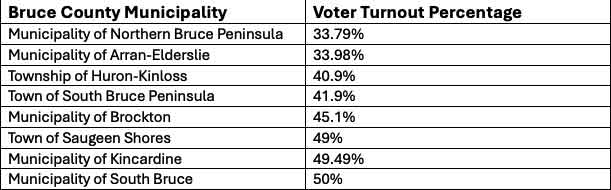
MNBP had the lowest voter turnout percentage of all Bruce County (BC) municipalities at 33.79%. The Municipality of South Bruce including communities like Mildmay and Teeswater had an above average turnout of 50% with the majority of other BC municipalities within the 40% range.