



John Francis,
Bruce Peninsula Press
The purpose of a national park is to preserve and present Canada’s natural environment. To quote a recent media release “…keeping ecosystems healthy and protecting the long-term health of the broader ecosystem.”
Looking at it from 40,000 feet, that should be easy, right? Preserve the forests and lakes.

On the ground or in the water, it gets pretty complicated. How do you preserve the aquatic ecosystem when it is dominated by invasives: Zebra and Quagga Mussels, Round Gobies, alewives, lampreys, salmon and so many more? What does preservation even mean?
The forest environments have changed just as dramatically, although most of the dominant species are still native — fir, cedar and aspen now dominate where hemlock, maple and beech used to rule.
On land, invasive species are most destructive in wetlands, open habitats and forest edges. Parks Canada’s Spencer Bennett gave a presentation about this at the Sources of Knowledge Forum in Tobermory this spring.
Bennett began by defining the difference between alien species and invasives. Any species which has been introduced to our area is alien — think dandelions — whereas invasives are species that can take over habitats and choke out the native species the parks are trying to protect.
Bennett has accepted a promotion to Wood Buffalo National Park in Alberta; Anna Fletcher now manages the invasive species at Bruce Peninsula National Park/Fathom Five National Marine Park.
She told me that our parks are monitoring 496 known infestations at 86 different sites, involving 28 different invasive species.
The threats are serious, but the manpower required to eliminate any given infestation — once firmly established — tends to be prohibitive. So the objective is management and control rather than elimination. “It’s a long game we’re playing,” Fletcher explains — trying to maintain an environment where native species can still thrive.
The most visible of the invasives is, of course, phragmites — the five-metre-tall reed that has taken over so many of our wetlands and wetland edges. It chokes out the native plant species that everything evolved to live around — creating an alien environment that our frogs, turtles, birds and fish can’t survive in.
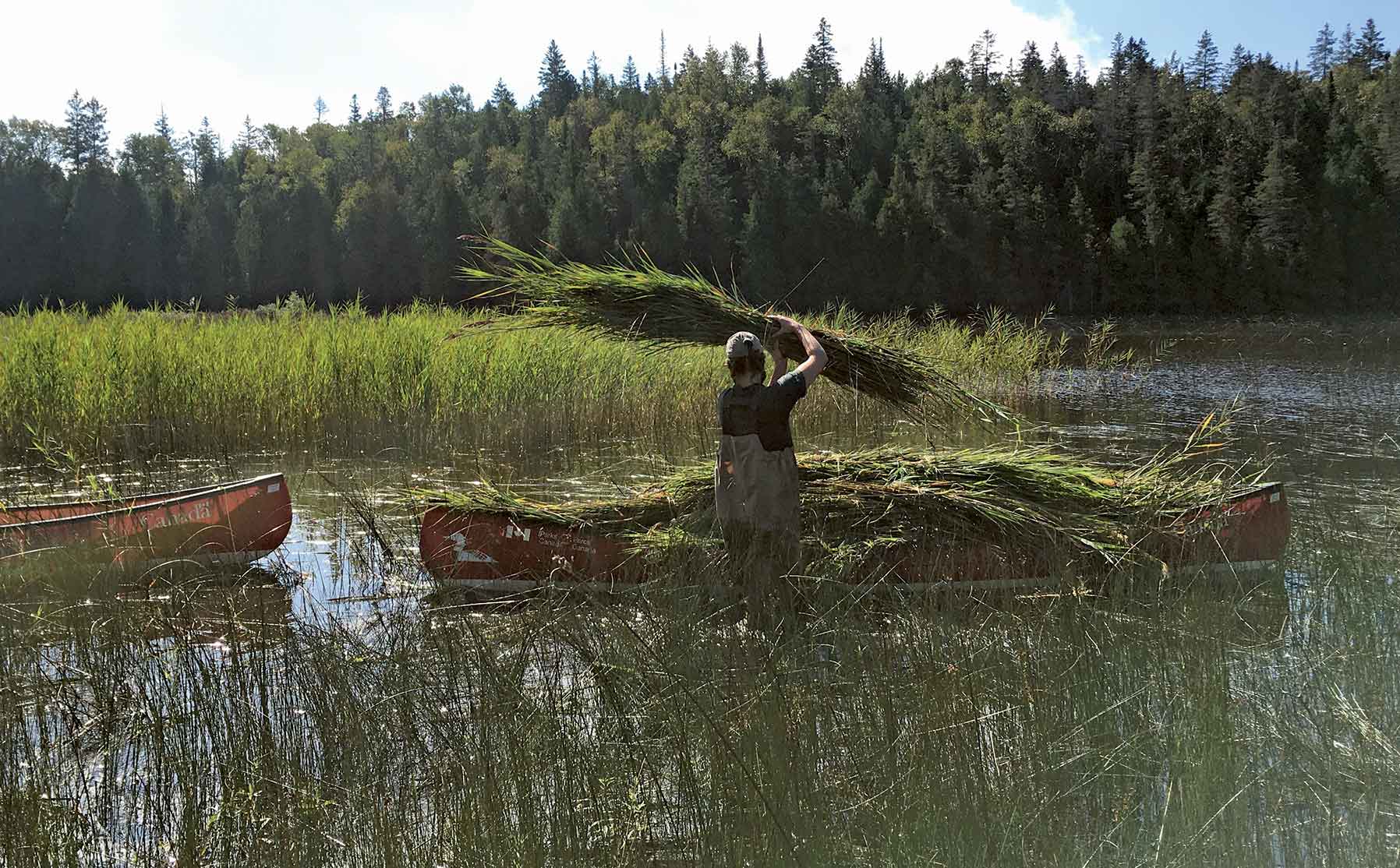
Trying to control “phrag” is a time-consuming nightmare. The best chemical-free control technique is to drown it — cut the stems below the water level so that the roots can’t use the leaves and stems to breathe. But phrag also produces huge seed heads, which must be gathered carefully and disposed of. The cut/haul/drown technique is not 100% effective and must be done repeatedly to eliminate any one infestation. Parks is watching/managing 255 patches of phrag distributed over dozens of sites.
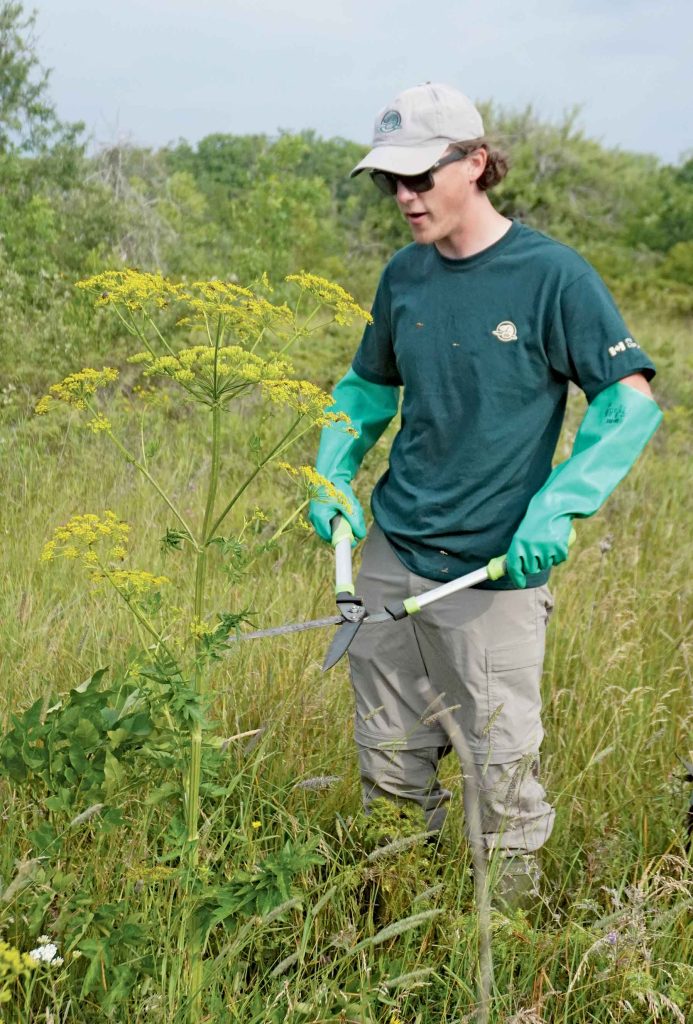
The second-worst invasive is Wild Parsnip, a member of the carrot family. Parsnip requires a totally different management approach because it is a biennial, not a perennial, which means its seeds are much more viable than those of phrag. A parsnip plant can produce 975 seeds, which remain viable for about 9 years.
Parsnip is not just an environmental problem — its sap can also make skin so light-sensitive that severe sunburn can develop in a few minutes of direct sun. Parsnip is highly visible along Highway 6 and other roadsides in the Lindsay Flats area. It’s a tall plant with greenish-yellow flowers; it blooms in July. Ontario Department of Transport and Bruce County have both been spraying roadsides for years in an attempt to control Wild Parsnip.
Parks personnel have used chemical and mechanical techniques to dramatically reduce the extent of the 36 Wild Parsnip infestations in our parks.
Filling out the top five threats at our parks are Garlic Mustard (46 know infestations), Wild Chervil (only 11 known infestations in our parks now but it’s spreading fast south of Owen Sound) and Purple Loosestrife (34 known infestations).
Each of these species (and 23 others) requires its own, targeted management strategy. Fletcher’s team must share effort with bear management, ecological integrity, species at risk (think rattlesnakes and turtles), ecological impact assessments and research. Oh, and support the fire team.
It is, as Anna Fletcher says, a long game.