




Could a Family of Visitors Survive a Week on the Saugeen/Bruce Peninsula Without a Car? Could You?
By John Francis
On March 28, Bruce Peninsula Environment Group and Bruce Peninsula Biosphere Association hosted a meeting and strategy session at Summer House Park. The focus of the gathering was the Northern Bruce Peninsula Climate Action Plan. BPEG/BPBA be writing it up, so I won’t deal with the substance of the meeting here.

But I was struck by a couple of things that were baked into the discussion.
Clearly, greenhouse gases (GHGs) are the most critical environmental issue of our time. In MNBP (Municipality of Northern Bruce Peninsula), as with most places, more than half of the GHGs come from transportation. In second place is home heating. Third place is waste gases from landfill.
So there are obvious low-hanging fruit: switch to electric vehicles (EVs) and switch to electric heat pumps. (BTW — we put in an air-source heat pump/air conditioner at our home last fall. It heated the house perfectly all winter, even on the coldest days, and it cut our heating bill in half.)
But someone pointed out that the largest source of vehicular emissions in MNBP is tourists, not locals. Duh. They outnumber us by about ten to one!
So what can we do to mitigate the GHG emissions from tourists?
The most obvious answer is providing charging stations for EVs. For example, the bank of chargers at the community centre in Tobermory, which haven’t worked in years…
But another answer in reducing the GHG emissions of transport is improving public transit, especially electric-powered public transit. If tourists could come here on electric buses, that would dramatically reduce their GHG footprint.
But how would that work? It would mean that visitors wouldn’t have a vehicle when they got here.
Would that be a problem?
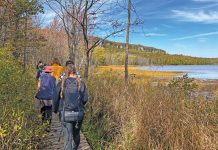
Imagine spending a week in Lion’s Head without a vehicle. Would you be able to visit the main attractions?
I’m assuming that there are three main attractions: Lion’s Head Beach Park (and the adjacent marina), the Bruce Trail in Lion’s Head Provincial Park and the Bruce Trail north from Whippoorwill Shore. Those three are, respectively, a five minute walk, a ten-minute walk and a fifteen-minute bike ride from downtown Lion’s Head.
So you could spend a lovely week in Lion’s Head without a car.
How about Tobermory? What would you do if you were spending a week in Tobermory without a car?
For sure you’d take a boat tour and spend a day on Flowerpot Island.
But after that?
Go to Singing Sands? Google Maps says that’s two hours and twenty-five minutes walking or 32 minutes on a bicycle.
Go to the Grotto? That’s 52 minutes on a bicycle or a four-hour walk. (You aren’t actually allowed to walk there.)
Halfway Log Dump? Five hour walk or two hours fifteen minutes on a bike.
Even Big Tub Lighthouse is a 41-minute walk from downtown Tobermory. (And an unpleasant 41 minutes at that — pedestrians have to share a narrow roadway with two lanes of traffic.)
No wonder everybody brings a car when they come to Tobermory! (And to every other place on the peninsula except Lion’s Head.)
So what can or should we do to reduce GHG emissions from tourism?
There would seem to be three strategies here:
• shuttle buses; and/or
• make it easier and more pleasant to come here in an EV; and especially:
• make it easier and more pleasant to walk or cycle around our villages.
So: shuttle buses, sidewalks, bike lanes and charging stations.
But attendees at the meeting had a few other suggestions: free parking for EVs; free (or reduced) fares on the Chi-Cheemaun ferry; free (or reduced, or priority) admission to the National Parks.
As to the GHG footprint of MNBP residents: we should all buy electric cars, right? (And heat pumps!)
Special Bonus Feature: I’m guessing gas prices might double again before the political situation settles down, and there might be shortages as well. Those would be particularly onerous in rural areas where you have to drive everywhere.
Wouldn’t it be nice to not care how high the gas price goes or whether the supply runs out?