



By John Francis
We just spent a week in Lisbon, Portugal — our first international holiday since the plague. We were struck by a number of things: similarities, differences, contrasts.
Six hundred years ago, Lisbon was the commercial and cultural centre of the western world, with Henry The Navigator’s discoveries laying distant lands open to Portuguese explorers. But that was then. Now, Lisbon is almost a backwater compared to Paris or London or Rotterdam.

Compared to other major European capitals, Lisbon has very few ancient buildings. The city was flattened by an earthquake in 1755 and anything that was left standing caught fire. It was rebuilt immediately (planned and supervised by a brilliant madman, but that’s another story) so most of the buildings are only 265 or 270 years old.
270 years ago, the Saugeen Bruce Peninsula was populated entirely by… the Saugeen. It wasn’t extorted from them for another hundred years, but that’s another story, too. (Nice little peninsula you got here; it’d be a shame if…)
Whereas downtown Lisbon has thousands of buildings that are 265 years old, our municipality has none.
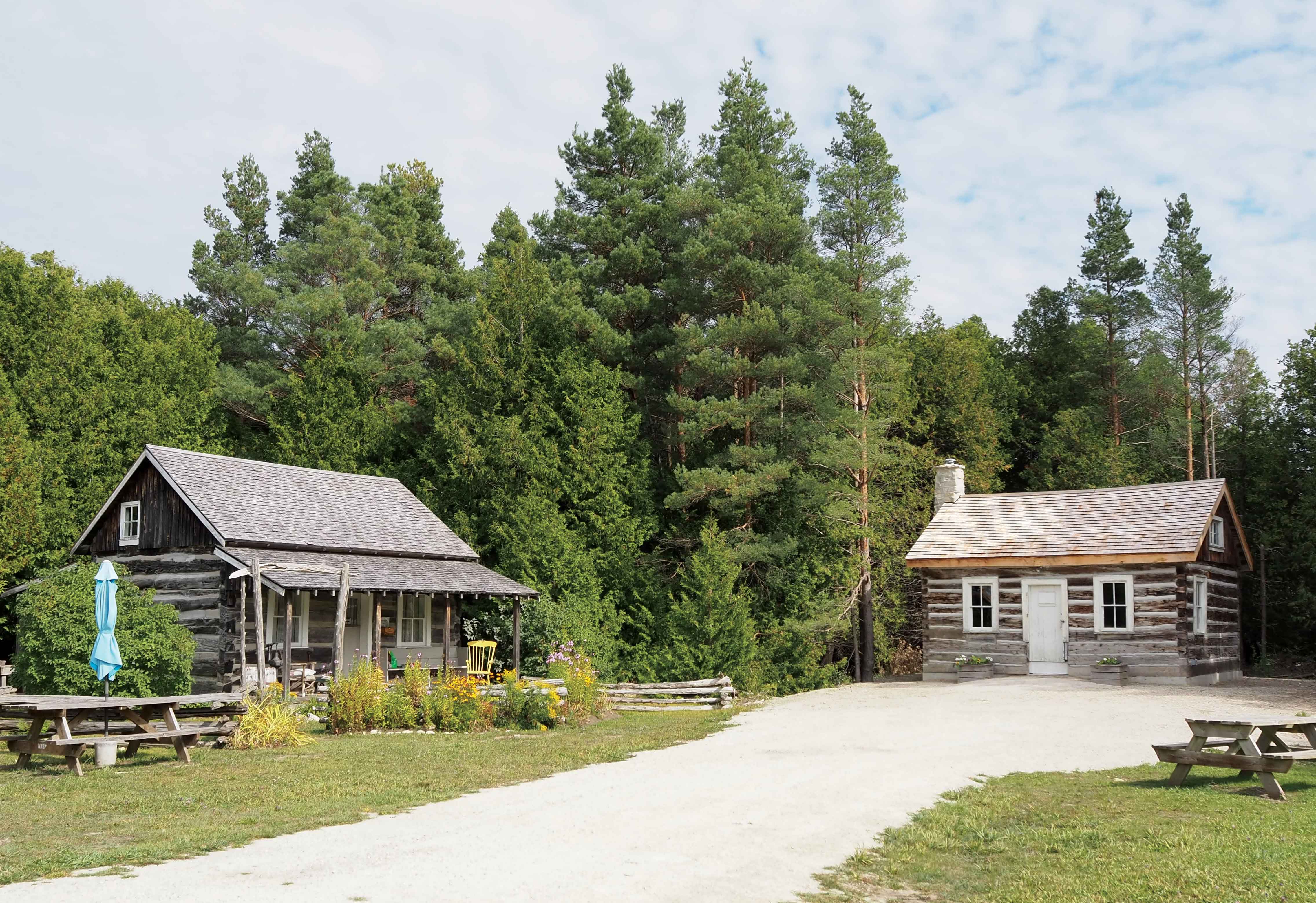
In fact we have one building from the 1850s (Cove Island Lightstation) and two from the 1870s (the Belrose cabin and the Davis cabin, both preserved at the museum in Tobermory).
Two other buildings date from the late 1890s — the SS #2 brick schoolhouse at Tobermory museum and the Eastnor Hall (Rotary Hall) in Lion’s Head.
To the best of my knowledge, that’s it. (Question: does the Settlement Methodist Church aka the United Church Thrift Store, date to 1886? Probably not but I’m in Tenerife and have no way of verifying…)
We are very fortunate that the lightstation is a federal asset and the other four buildings are municipal assets. They will be preserved.
* * * * *
In the last couple of years, Tobermory has lost a couple of people who had a direct connection to those buildings. Viola (Watson) Adams was born in Tobermory in the late 1920s and was a stalwart citizen of the community her whole life. Vi went to school at SS#2 back when it was a school and married Lloyd Adams who grew up in the Belrose cabin.
Think of the depth of knowledge about Tobermory’s history that died with her.
* * * * *
I had a delightful conversation with Vi Adams a year or so before she died. I wish I’d recorded it. She gave me a sense of what it was like to walk on the dusty road to school on hot September days 90 years ago. It was as if I could share her bewilderment when a polite young boy named Lloyd Adams followed her home from school one day in the hope that she would chat with him. (She gave in after a day or two…)
* * * * *
It makes me wonder how many more buildings there are out there that date back to the 19th century. (If you know of one, please contact me — info@tobermorypress.com). It makes me wonder how many of our seniors know things about those buildings and what it was like to live in and around them.
To put it bluntly: the buildings are falling down and the people who know about them are dying.
It seems to me that it ought to be a priority to develop some kind of list of our oldest buildings. It should also be a priority to learn as much as we can from the seniors who are still with us.
* * * * *
It’s not that we have nothing in our public records. There are books and reports.
There’s Benchmarks, the official history of Eastnor Township, Proud People, Allen Bartley’s history of Lindsay Township, and Hewers of the Forest, Fishers of the Lake, the official history of Tobermory and St Edmunds Township.
There’s an excellent history of the village of Lion’s Head, courtesy of the late Walter Warder; it’s called Between You and Me and the Gatepost. There were two earlier, unpublished reports as well.
More recently, there have been histories of Edenhurst, Barrow Bay and Pike Bay and a number of personal histories, all of which contain wonderful nuance and detail about what it was like to live without electricity, running water or passable roads.
But I want more.
I am fascinated by Stokes Bay.
135 years ago, it was the most dynamic place on the peninsula. It was a commercial shipping port, with hotels, restaurants, outfitters and merchants. It was the gateway to the north because the road/trail to McVicar and Tobermory started in Stokes Bay.
What was the route of that road?
The peninsula’s first school was just north of Stokes Bay. But where? What happened to the building? Where were the hotels? What did the docks look like? Who lived there?
There are resources available to us in 2026 — people, documents, the footings and foundations of old buildings — that will soon be lost to the sands of time.
Maybe there would be Trillium Grants if we had somebody to apply for them.
Who wants to start a Saugeen Bruce Peninsula Historical Society? I’d love to help organize one. Email info@tobermorypress.com if you’re interested.