




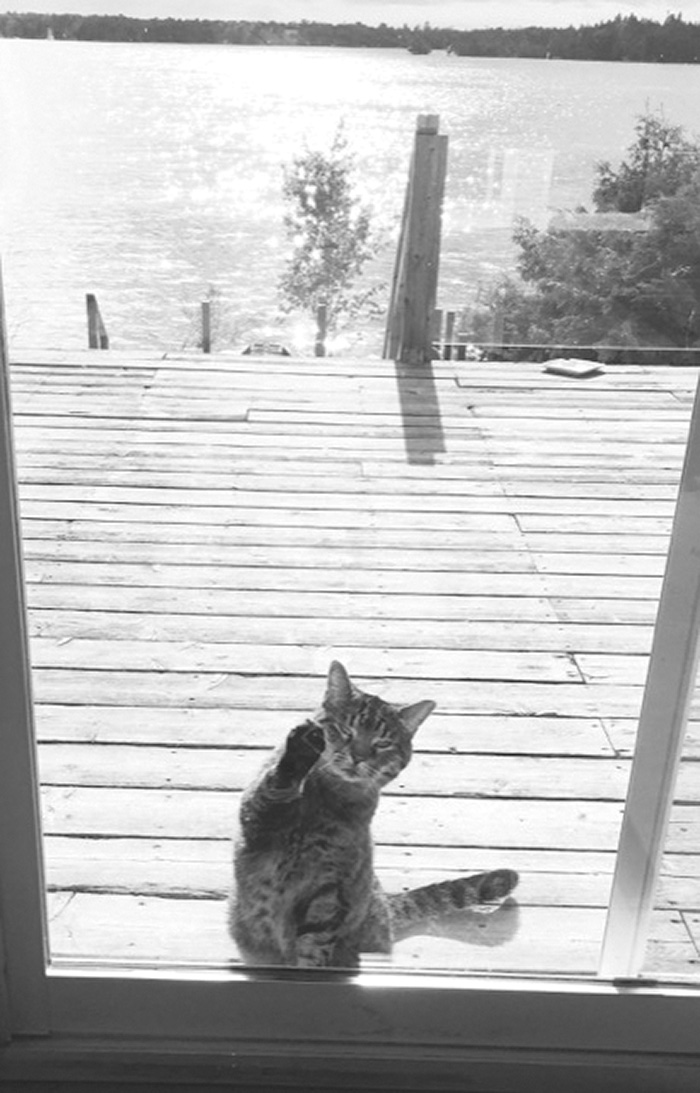
Olli came from inauspicious beginnings. In October 2008, when my twelve year old daughter and I went looking for a new kitty. Olli was a little older than the average kitten, at about 3 months; found with his brother in an old tire in a nearby ravine by a volunteer.
He came home with us.

Named Olivander, after Harry Potter’s wand-wizard, we quickly adapted to calling him Olli. His first task was to meet our 18 month old dog, Bean. It was love at first site. Bean’s gentle demeanor allowed Olli to follow him around, learn how to suck up, and become an essential member of the household. Olli was an official junior dog. Olli often came on the last walk of the day, around the quiet residential block, racing past us as we would enter the door.
He was kept indoors for his first few months of living with us. Then, one cold January day, we decided he could go outside, thinking he’d be back asap. Instead, he returned after 8 hours, a gift of 3 dead rats lined up on our deck. From then on he spent parts of the day outdoors, longer during the nice months, and in the winter sometimes just a perfunctory trip to his outdoor bathroom in our garden, then quickly back at the door.
To get our attention, Olli learned to swipe his paws vertically on the glass of our doors, making a distinct squeegee sound, his trademark doorbell.
Olli was the king of our Toronto quiet street. Locals with outdoor mice or rat problems suddenly had no more worries. He enjoyed his success by co-opting other people’s verandahs, using them to sit and watch the neighbourhood goings on, especially the ones at our house.
In 2019 on the night when Bean was in distress at home, Olli circled the heavily panting dog, kissing him on the head. They weren’t often affectionate, this was obviously a special night. Bean died a few hours later.
Afterwards, Olli more affectionate, tuned-in and more demanding of attention. Junior dog status was retained, taking care to be near.
In 2019 he cleared out the mice in the basement of our new house in Tobermory, and outdoors took a few voles. No birds – at 11 years old he’d become less able to jump after feathered temptations.
We often felt like he was in charge, letting us know when his bowl was empty/needed a belly rub/felt like doing yoga on our mats (while we were doing yoga on our mats). (He) learned to sit and shake a paw, and never missed giving a cat ‘hello’ when he entered a room.
As an outdoor cat in Tobermory, tentatively let out with a strict curfew. Home by 8:30, sometimes stretching it later when the sun stayed high until 9:30 pm. Sometimes showing up early, squeegeeing the door, and having a snack. Then resigned to be in for the night, until morning. We had heard stories of fishers showing up on people’s decks, and were vigilant about ensuring he was home every evening.
He was happy to be able to spend his time outside, napping in my raised vegetable garden, and coming to Lake Huron while we swam. We slowly let our guards down.
Tobermory, Monday, September 12, out as usual. Humans: dinner and a movie on TV, forgetting to be out at 8:30 calling him. At 11 pm and he was not home. Using a flashlight and his metal bowl and kibble, I walked up Eagle Road, rattling food, calling. No Olli. Awake with all the exterior lights on, until 1:30 am, waking at 5 to realize he hadn’t arrived home yet, back out again. Nothing.
Over the next 4 days we went out many times combing the Bruce Peninsula Park. No luck.
Here’s some advice: if your cat goes missing DO NOT look up “coyote attacks on cats” on YouTube. It is swift, gruesome and decisive… and, I fear, is what happened to my fun junior dog. He was just a meal to a predator, but he was the world to us.
I now reluctantly share my story, about bringing an outdoor cat to the North Bruce.
If you love them, keep your beloved cats indoors.
Bev Dywan
Eagle Rd Tobermory