


Submitted by Brenda Stewart, Archivist, Peninsula Bruce Trail Club,
The iconic stone cairn that stands along the harbor in Tobermory to mark the northern end of the Bruce Trail has been photographed with thousands of individuals to mark the end of their E2E hiking journey. A bronze plaque on the cairn states, “THIS CAIRN MARKS THE NORTHERN TERMINUS OF THE BRUCE TRAIL, A CROSS-COUNTRY FOOT TRAIL ESTABLISHED ALONG OR ADJACENT TO THE NIAGARA ESCARPMENT EXTENDING FROM QUEENSTON ON THE NIAGARA RIVER IN THE SOUTH TO THIS NORTHERN TERMINUS IN TOBERMORY, OFFICIALLY OPENED DURING CANADA’S CENTENNIAL, JUNE 10, 1967.”
The cairn was designed for the Bruce Trail Association by Ruth Arnsberger, and built by Ivan Lemcke, of Barrow Bay.

The following is excerpted from two articles written for the Peninsula Club’s Rattler Newsletter in 2005 and 2022, by Ross McLean. It tells the story of the building of the Cairn:
“The end-to-end hiker, upon arrival in Tobermory, sees the cairn as the symbol of the completion of his quest. Unveiled in 1967, to mark the official opening of the Bruce Trail, it stands proudly overlooking the waters of Little Tub Harbour.”
“The idea of a cairn arose in 1966 during the planning for the official opening the next year. The BTA (Bruce Trail Association) Board at its September meeting approved the erection of the cairn in Tobermory and authorized an expenditure of up to $1,000.00. The BTA archives contains a letter from October 4, 1966, from the clerk of St. Edmunds Township, authorizing the use of public lands for the cairn. The fact that J.P. Johnstone was both a BTA Board member and the Reeve of the local township obviously expedited this decision!”
“Ron Gatis took the local leadership for the design and building of the cairn. First, he approached Ruth Arnsberger, an accomplished artist and weaver from Norway who discovered the Bruce Peninsula in the 1950s, and then “kept on staying and never left”. Ruth accepted the offer to design the cairn, and for her creative efforts received the princely sum of $50.00.”
“Ruth hung the full-scale design from a doorframe in her home so that it was a life-size seven feet tall. In the centre, a hole was left for the free-standing Bruce Trail arrow: to Ruth, this was the key symbol for “a free trail where you could go where you wished.” Grif Ebel of the Ebel Quarry to the west of Wiarton cut and donated the arrow.”
“The next stage was the building of the cairn and Ron contracted Ivan Lemcke of Barrow Bay, a self-taught stone mason who a few years earlier had helped to open sections of the Trail near Lion’s Head. One spring day Ron, Ruth and Ivan journeyed to the west side of the Peninsula, in the Oliphant area, to gather rocks for the cairn. They drove them to Tobermory and deposited them under a tarp beside Little Tub Harbour, ready for construction to begin the next Monday. When Ivan returned after the weekend, he discovered the rocks 25 feet deep in the harbour. Obviously, the teenage boys of town had had a party! He and Ron had no other choice than to head back to the west side, and as Ivan remembered, “the black flies were thick.”
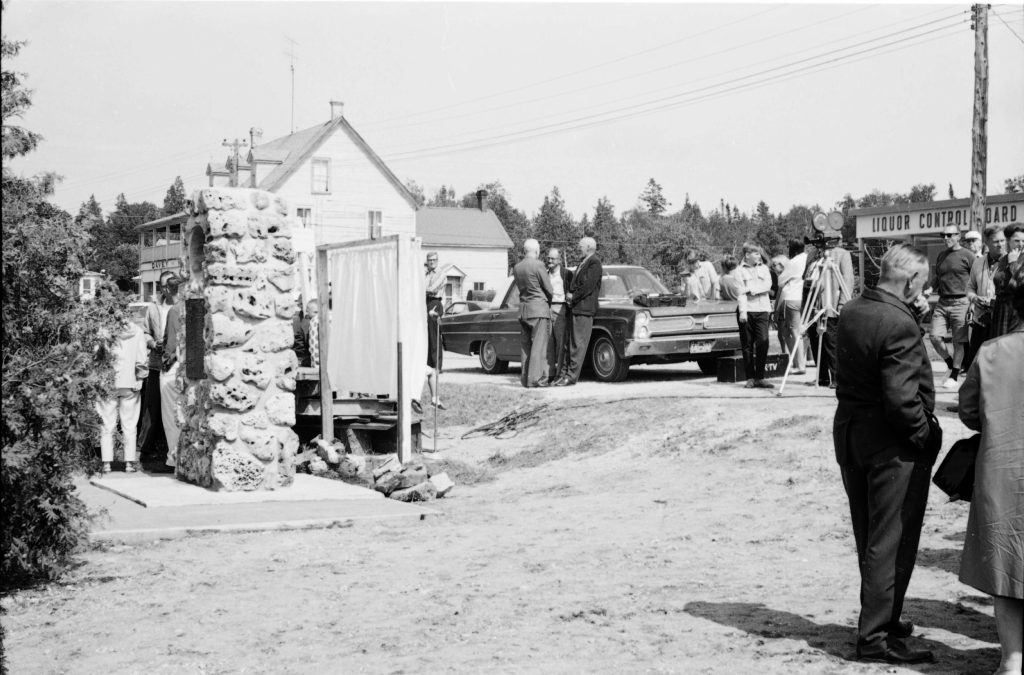
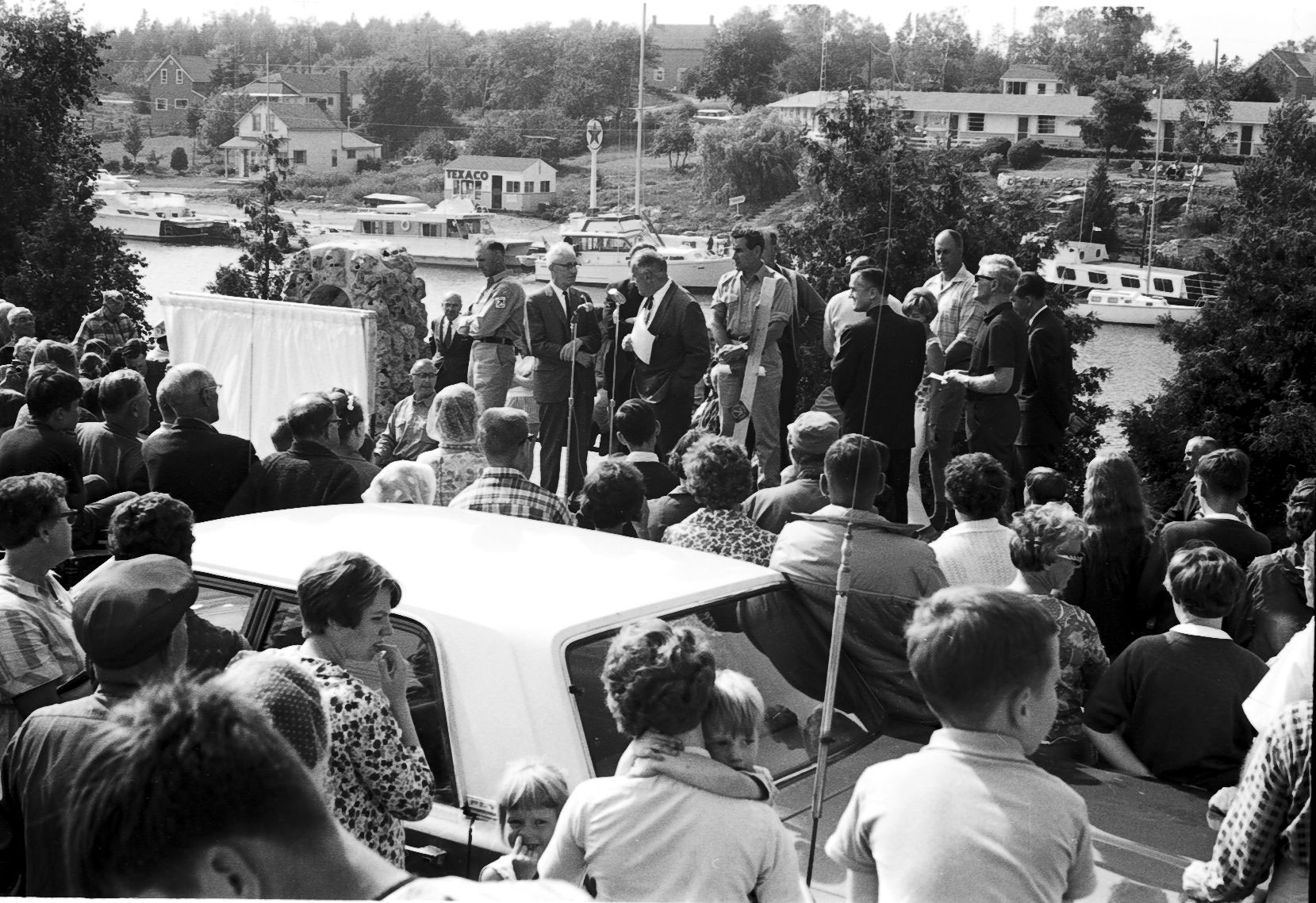
There is no mention in the archives why the cairn was not unveiled at the June 10, 1967 opening of the Bruce Trail, but it is surmised that the delay in obtaining more rocks prevented its completion before the ceremonies. Instead, the cairn was unveiled on August 8, 1967, at the beginning of the Duke of Edinburgh Award gold medal winners’ hike from Tobermory to Harrison Park in Owen Sound. Present that day were Dr. Cy Hauch, then-president of the BTA; Norman Pearson, the first BTA president; Rene Brunelle, Minister of Lands and Forests; and Ruth and Ivan, along with the Duke of Edinburgh hikers. 27 youth representing 14 Commonwealth countries were led by Lord Hunt who had been the director of the Mount Everest expedition in 1953, the first ascent of the world’s highest peak. Lord Hunt officially unveiled the cairn. A plaque on its face identifies the Bruce Trail, and on its back facing the water is a plaque listing the names of all the hike’s participants. The most recorded incident that day involved the hay wagon which was used as a stage. It was a flat rack with its end projecting far over its axle. Too many people climbed on for the unveiling and it suddenly tilted, nearly throwing the people to the ground. They all scrambled to the high side and after a good laugh, the proceedings were ready to begin. Lord Hunt in his address said, “I always was afraid of heights and now I am terrified!”
“In 2003 the Peninsula Bruce Trail Club Board had a small plaque installed at the base of the cairn to honour both Ruth Arnsberger as the designer and Ivan Lemcke as the builder. In 2013 the Board has authorized repair work for the cairn so that it can enter its next fifty years with pride and grace.”
To read the full articles in the Rattler newsletter, or to learn more about the PBTC’s early pioneers, check out the History page on our website at www.pbtc.ca.